


Lisbon, Portugal

Lisbon Digital Nomad Guide: Living, Working and Budgets for 2026
Original guide by Melanie Kruger, first published 8 August 2020. Editorial information and budget review: 14 September 2026. The personal account below reflects the author’s original experience.
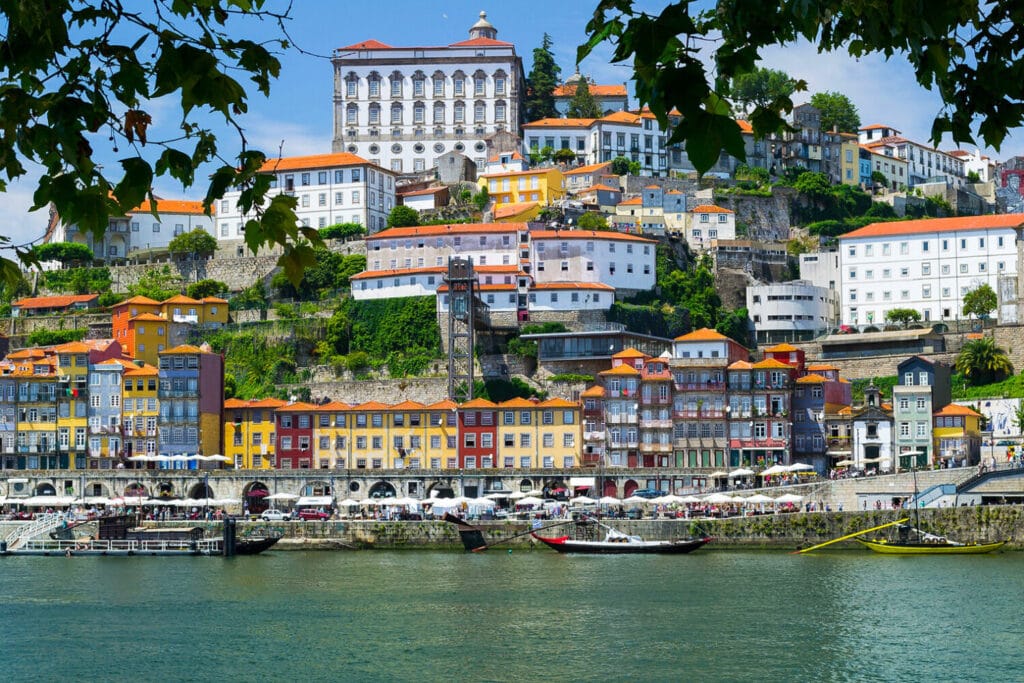
Located in western Portugal on the estuary of the Tagus (Tejo) River, Lisbon draws digital nomads with its waterfront, distinctive neighbourhoods, Portuguese food and international community. It is a place that can make an ordinary working day feel special: a coffee by the river, a walk through tiled streets, then a few hours in a lively coworking space.
Housing needs more careful budgeting than older Lisbon guides suggest. For September 2026 planning, allow approximately €1,300–€1,900 a month with a room in a shared home, €2,400–€3,500 for a solo worker renting a furnished private apartment, or €3,400–€4,600 for two adults sharing an apartment. These are editorial scenarios, not measured city averages or guaranteed prices. The full cost-of-living section below shows the assumptions, evidence and exclusions.
There’s no denying the appeal of Lisbon’s sunny days, outdoor cafés and waterfront evenings. Its coworking scene gives remote workers options beyond the kitchen table, while its cultural life leaves plenty to explore after closing the laptop.
There’s a lot to get involved with in the community for both new and current expats residing in Lisbon, and from workshops and skill-sharing events to stand-up comedy nights and socials, it couldn’t be easier to integrate yourself into city life and you’ll quickly start to feel at home.
Add to that the warmth and friendliness of the locals, an impressive arts and culture scene and the plethora of bars, eateries and viewpoints that are located in easy walking distances of most of the city’s main neighbourhoods, and it’s the perfect base that offers quality of life and supports just the right balance of work and play.
Solo in a shared home: €1,499/month (illustrative)
Living in Lisbon Overview
Costs at a glance
Living arrangement | Illustrative monthly budget |
|---|---|
Solo, room in shared home | €1,499 |
Solo, furnished private apartment | €2,924 |
Couple, one apartment | €3,898 for two adults |
These examples include accommodation, food, transport, workspace and other everyday allowances. They reflect daily life in Lisbon and exclude flights, deposits, income tax, business expenses, visas and childcare. Utilities should be removed if included in rent. Read the detailed budget at the end before using any total as your own spending target.
| Child Friendly |  |
| Cultural Tolerance | |
| LGBTQ Friendly |  |
| Traffic Safety |  |
| Nightlife | |
| Large DN Community |  |
| Young Community | |
| Proper Hygiene | |
| Clean | |
| Emergency Numbers | Police | 112 |
| Ambulance | 112 | |
| Fire-fighters | 112 | |
| Money Handling | Currency | Euro (€) |
| Max ATM withdrawal | €200-€400 | |
| Tipping | Yes | |
| Communication | Languages | Portuguese |
| Calling code | +351 | |
| Time zone | UTC-01:00 (WET) UTC+01:00 (WEST) | |
| Health | Tap Water | Drinkable |
| Vaccinations | None |
MotoSharing

Cooltra is the mobility app for renting motorcycles and electric scooters as well as a motosharing service in 6 cities. If you knew eCooltra, we now offer daily and monthly motorcycle rental so you can ride whenever and wherever you want.
Home Renting

If you are looking for a home, our team has analysed the experiences of our millions of users to provide the best property search engine possible. It’s especially useful when you’re on the road and want to know if there is any property of interest…
Travel & Local

One click, and you will have of all information about Cascais. Do you want to visit a museum, a garden or just go to the beach? With Agenda Cascais you can find out everything about these spaces, from their location to their description.
Average Temperature °C
Average Temperature °F
Average Rainfall
Average Rain Days
Daily Sunshine Hours
Features and practical information
Lisbon suits people who enjoy a walkable city with hills, a social work scene and easy access to cultural activities. Your experience will depend heavily on the actual building and street: central nightlife, steep stairs and an uncomfortable home office can matter more than a neighbourhood’s reputation.
Portugal uses the euro. Keep rental quotes and your household budget in euros, then account separately for the exchange rate and fees your bank applies. For a stay beyond a holiday, check your right to reside and work before signing a long accommodation commitment.
Useful apps and planning tools
Keep the Lisbon Metro website handy for ticket products and journey planning. A map with saved home and coworking locations helps you compare daily routes. Current event listings on Meetup can help you find groups, but confirm the organiser and date rather than relying on an old recurring-event description.
Weather
Expect a different routine in dry summer weather and the wetter winter season. Check forecasts for your dates and ask about heating, ventilation and cooling in your accommodation. The best-time-to-visit section below explains the practical trade-offs.
Digital Nomad Personal Experience in Lisbon
Melanie Kruger’s original account. These are historical personal impressions; current practical details are covered in the editorial sections that follow.
For me, it was this slower pace of life that won me over, and the countless like-minded souls that I met during my time here. Lisbon is booming with new start-ups and innovative hubs, which means it attracts a positive crowd with big goals in mind, but it was the open-mindedness and maturity of those whose paths crossed mine and the exciting and meaningful conversations that made the experience what it was.
Waking up each morning and wandering down to the river for a coffee at sunrise is the ultimate way to start each day in Lisbon, and descending its pretty, hilly streets, which are lined with intricately-tiled buildings with colourful façades, before the city wakes up is something truly special indeed, and a chance to see Lisbon in a different and all-together more peaceful light.
With trendy Wi-Fi cafes that make for the perfect casual workspaces mushrooming, it couldn’t be easier to find a place to set yourself up for the day, and in fact, the working week has never felt quite so appealing.
During my stay, nomad organisations and coworking socials made it easier to meet people, make connections, and make friends more quickly. Those informal conversations in a coffee shop could be just as valuable as an organised event.
Editorial note: check current organiser calendars before attending; this account does not establish that the same weekly events still run.
Lisbon has something for everyone, and for me, its rich blend of Portuguese culture, the mouth-watering local foodie scene and the spectacular viewpoints you can’t help but stumble across daily all added to its endless charm. It’s smaller than the vast expanse of London, which makes it easier and more convenient to explore, and each neighbourhood has its own unique vibe. Finding accommodation here, admittedly, can be tricky.
Even so, the community, culture and balance of work and play were what made Lisbon memorable for me.

Work in Lisbon
Lisbon offers a great variety of creative and inspirational co-working spaces for digital nomads and other freelancers, and has been quick to embrace the work-where-there’s-Wi-Fi culture that comes with both. The spaces here aren’t just your usual, run-of-the-mill open plan office spaces, and you can expect to find a vibrant and uplifting space to suit all tastes. And, if you prefer an even more casual option, then you can head to one of the city’s many diverse coffee shops and cafes, which offer excellent capability, wonderful coffee and of course, pasteis-de-nata that are simply to die for.
With such a lot of choice, it’s tempting to work your way around them all – and better still, you can.
Here are some of the top co-working spaces and coffee shops with Wi-Fi in the city to consider for those days where you want to get stuff done. As an added bonus, they are also great places to meet other digital nomads, and enhance your Lisbon social scene as a result.
For remote work, the connection inside your accommodation matters more than a citywide average. Ask for a recent upload and download speed test, check the desk and chair, and confirm whether the workspace has quiet rooms for calls. Keep a mobile-data backup if losing a connection would disrupt your work.
Best Places to Work in Lisbon
Co-working spaces in Lisbon
Avila Spaces
Avila Spaces offers a more business-oriented alternative to a casual café, with coworking, meeting rooms and office options. Its current locations include Avenida da República, Atrium Saldanha and Parque das Nações, so compare the commute from your accommodation before choosing.
The provider advertises coworking from €200 a month. Confirm the specific package, tax treatment, access hours and meeting-room allowance before treating that starting price as a quote. A virtual-office service is a different product from a usable desk. Avila Spaces.
Time to Cowork
If you’re looking for a work base near Cais do Sodré, Time to Cowork is at Avenida 24 de Julho, 3, 1st floor left. The combination of a central location and flexible passes makes it a useful option when your travel plans are still taking shape.
Its published menu lists €12 for a half-day, €20 for a day, €50 for three days, €80 for five consecutive weekdays and €150 for ten weekdays, all plus VAT. A resident permanent desk starts at €250 a month plus VAT and includes 24-hour access. Confirm pass validity and the final tax-inclusive payment for your chosen product. Time to Cowork memberships.
Think about how many days you will realistically use a desk. Someone who spends mornings exploring and works only occasionally in a shared office may find a pass more useful than a permanent desk; someone taking daily calls should prioritise call space and reliable access.
Impact Hub
Impact Hub Lisbon combines workspace with a community focused on entrepreneurship and social impact. It is worth exploring if you want your office to be a place for conversations, events and professional connections as well as focused work.
Ask the team for the current Lisbon location, desk availability and full membership quote. The original guide’s address list and day/week/month prices are not a reliable current rate card. Confirm meeting-room access, guest rules and whether events require separate booking. Impact Hub Lisbon.
Heden
Heden remains an option for people who want flexible access, with its current desk page listing locations including Rossio, Santa Apolónia and Alvalade. Choose the site that fits your working routine rather than using the original guide’s older Graça address.
Published starting prices are €10 for a half-day, €99 for a ten-day pass and €179 for a monthly pass, including IVA. The ten-day product is used within its stated two-month period; it is not unlimited monthly access. Confirm the location and access level before booking. Heden desk products.
Our budget examples use the ten-day pass for a room-sharing traveller and a monthly pass for a full-time workspace user. For more options, see our Lisbon coworking guide, then check each venue’s current terms directly.
Cafes with Wi-Fi
If you’re looking for somewhere more casual, the cafés below are places to investigate. Ask about laptop policies, busy meal periods and calls before settling in: a good café is not automatically an all-day office. Buy something, be considerate of limited seating and use a dedicated workspace for long meetings.
Copenhagen Coffee Lab – A favourite amongst Lisbon’s digital nomads thanks to its chilled vibe and excellent coffee.
Address: R. Nova da Piedade 10, 1200-192 Lisboa
The Mill – Known for its coffee and Portuguese-Australian café style; check laptop policies for your visit.
Address: R. do Poço dos Negros 1, 1200-335 Lisboa
Hello Kristof – simple, Nordic inspired décor and a selection of international magazines to keep you occupied during screen breaks.
Address: R. do Poço dos Negros 103, 1200-337 Lisboa
Branches and policies can differ. Check Copenhagen Coffee Lab’s café directory, The Mill and Hello Kristof’s locations before making a working day depend on a particular table.
Best Places to Live in Lisbon
Best Neighbourhoods
Cais do Sodre
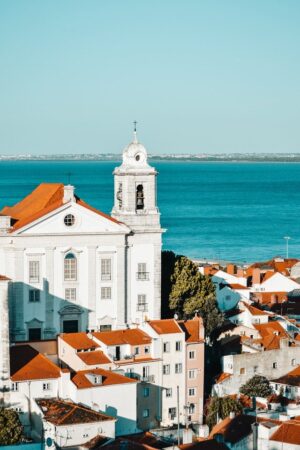
One of the most centrally located neighbourhoods in Lisbon, Cais do Sodre is a great place to base yourself for easy access to all of the city’s major sites and amenities and is close to the port, the Time Out Market (otherwise known as the Mercado da Ribeira, where you’ll find some of the best food in the city) and the iconic Pink Street.
The Ribeira das Naus waterfront, along the Tejo Estuary, is in walking distance, and a great place for a lunchtime stroll or for a post-work drink in the sunshine. From here, you can also jump on board one of the daily ferries to Cacilhas in Almada, on the other side of the river.
You’ll also find co-working space Outsite in the neighbourhood, which is an ideal location to work and to meet other digital nomads in the city.
Alfama
Alfama is one of Lisbon’s oldest neighbourhoods, known for its historic street pattern and hillside character. It’s also one of the most charming, and buzzes with life at almost every hour of the day or night. A maze of quaint, cobbled streets that wind their way up a steep hill overlooking the Rio Tejo, it has a distinctly ‘lived in’ feel, with the intricate and colourful tiles that adorn each home chipped and showing their age, and washing hanging out on the wrought-iron balconies – but that’s all part of its charm.
Pastelarias serve up strong coffee and pasteis de nata, music drifts from the many Fado bars in the area, and street vendors barbecue fish and serve liquor shots on the street.
The neighbourhood is also home to the iconic Sao Jorge Castle, and on Tuesdays and Saturdays, the streets come alive with the Feira da Ladra flea market. A must at sunset is to make your way up to the spectacular Miradouro de Santa Luzia, which offers sweeping views of the Alfama rooftops framed by grapevine-draped terraces, and a vibrant atmosphere of live music, dancing, drinking and socialising.
Príncipe Real
The trendy and upmarket neighbourhood of Principe Real is a haven for foodies and culture vultures alike, and is home to some of Lisbon’s best boutique shops, high-end restaurants and trendy, speakeasy style bars. Located on one of the city’s ‘Seven Hills’, it also offers some great opportunities to take in some of the city’s best vistas.
Around Rua da Escola Politécnica, allow time for the neighbourhood’s shops and gardens, then continue towards the Miradouro de São Pedro de Alcântara for views across the city. Estrela Basilica, the 25 de Abril bridge and the Cristo Rei statue are separate sightseeing stops; they are not landmarks you pass simply by walking along this street.
Bairro Alto
A hilly neighbourhood filled with bohemian bars and stylish eateries, there’s no denying that Bairro Alto is one of the trendiest neighbourhoods in Lisbon, and also happens to be the place where most people head on a Saturday night to socialise. With this in mind, it can also be one of the busiest, but with its side-streets filled with apartments and one of the most breath-taking view-points – Miradouro de São Pedro de Alcântara – located right on your doorstep, if you can handle a little extra footfall then there’s a lot to love about living here.
With a distinctly cool and edgy vibe and a plethora of great restaurants, cafes and bars to choose from, it can be tricky to find accommodation here thanks to its popularity, but if you don’t mind the effort then it’ll be more than worth it.
Baixa & Rossio
With Baixa and Rossio being home to some of Lisbon’s main landmarks and most iconic sights, the neighbourhood which stretches between the two, in the city center, is the perfect choice for a base for first timers to the city, and offers a range of shopping and dining options, too. Destroyed during an earthquake in 1755, this ‘downtown’ area of the city was rebuilt in the 18th century. Here you can explore Praça do Comércio and the grid of downtown streets. A short walk into neighbouring Chiado brings you to Brasileira Café and the historic Livraria Bertrand.
Owing to its rich historic and cultural appeal, this neighbourhood is also particularly popular with tourists – so if you’ve visited Lisbon before or intend to stay for a while, then you might want to look for somewhere a little further out from the main throng.
Other neighbourhoods worth comparing
Include Alvalade, Avenidas Novas and Benfica in your search if you prefer an everyday residential routine. Compare the actual home, grocery shops and transport links rather than assuming that every address outside the visitor centre is cheaper.
In Cais do Sodré and Bairro Alto, ask which way the bedroom faces and whether bars operate below. In Alfama, consider stairs, luggage and the walk uphill. In any older building, ask about damp, heating and ventilation: pleasant weather outside does not guarantee a comfortable place to work indoors.
Find an Apartment in Lisbon
Start with three questions: how long are you staying, do you need a private apartment, and must the home be furnished and ready for immediate use?
Long-term rentals can have different documentation, deposits and commitments from flexible accommodation. A listing aimed at residents should not be presented as a price every one-month visitor can obtain.
For furnished options, compare the complete stay total, then divide by the number of nights. Check whether the displayed amount includes cleaning, utilities and service charges. Confirm occupancy limits before assuming a studio can accommodate a couple.
You can browse Flatio’s Lisbon rentals for flexible stays and compare conventional rental listings separately. Avoid assuming that one platform is always cheaper. Choose the actual property and terms.
Before booking, ask for:
A written total for your exact dates, including every mandatory fee.
Confirmation of whether electricity, water and internet are included, and any usage caps.
A recent internet speed test taken inside the apartment.
Photos of the desk, chair and sleeping area.
Heating, cooling, ventilation, noise and lift details.
Deposit, cancellation, extension and refund conditions.
If you need video calls throughout the day, a dining chair and a weak router may cost you more in lost productivity than you save in rent. A couple working simultaneously should ask whether there are two genuinely usable work areas.
How to spend less without making the month harder
A room in a shared home is usually the first scenario to investigate when your budget is tight. A kitchen and a predictable transport connection are often more useful than a cheaper address that requires regular taxis.
Compare dates outside your preferred week if you have flexibility. Ask for a quote for the complete stay rather than multiplying a promotional nightly price. Avoid committing to a long lease solely to make a short trip look affordable.
Treat low advertised prices as leads to investigate. Check the accommodation, landlord or booking platform and written terms before sending money. Do not assume an unusually cheap property will still be available when you arrive.
Cost of renting an apartment in Lisbon
The original €500 studio and €660 one-bedroom estimates should not guide a new arrival’s 2026 search. Our private-apartment example uses a €1,750 monthly rent allowance, while the full budget below separates a dated rental benchmark from furnished listing snapshots.
For conventional leases, browse Idealista and Casa Sapo alongside furnished-stay platforms. Compare documentation, minimum commitments and deposits separately. A long-term advertised rent is not necessarily available to a visitor booking one month.
If you prefer to inspect homes after arrival, budget for temporary accommodation and avoid assuming you will immediately secure the lowest advertised rent. Before paying remotely, verify the property and counterparty, review the written agreement and use the platform’s documented payment process.
Cheap Places to Stay in Lisbon
Hostels and coliving can help you settle in before choosing a longer-term home, but neither label guarantees a low monthly bill. Compare dorms, private rooms and an apartment for the same dates. A sociable rooftop is a bonus; a quiet sleeping space and somewhere to take calls are essentials when you are working.
Sunset Destination Hostel: Based at Cais do Sodré station, with a rooftop pool and communal spaces. It can be convenient for an introductory stay, but check whether your room choice and the station setting suit your working hours. Official accommodation page.
Secret Garden / Secret Patio listings: The original guide recommended Selina Secret Garden. Current booking listings use the Secret Patio name; check the present operator, exact property and included facilities before booking from an old recommendation. Current property listing.
Outsite Lisbon Cais do Sodré: The official property page describes 25 rooms, shared kitchens and ground-floor coworking. Compare the full stay price and any membership or workspace conditions. It is a coliving option, not automatically the cheapest accommodation. Outsite Lisbon.
For dorms, ask whether there is a separate place for calls and secure storage. For private rooms, confirm the bathroom arrangement, window, ventilation and desk. A room with shared living areas may be a better match than paying for a whole apartment, particularly if you want company in your first weeks.
Exclusive Member Benefits in Lisbon


Similar Digital Nomad Destinations
Exclusive Member Benefits in Lisbon
DNWorld’s Lisbon benefit pages include Watts on Wheels and The Base Lisbon Cowork. Confirm that the offer is currently active, that you are eligible and what the final price includes before adding a discount to your budget.
Similar Digital Nomad Destinations
Compare Lisbon with our guides to Ericeira, Seville and Ibiza. Start with the routine you want—city life, surf access or an island stay—then compare housing for the same season. Lisbon also works well as a base for comparing destinations elsewhere in Europe; use the Portugal overview for the wider context.
Portugal Visa for Lisbon
A spending budget is not an immigration income requirement. Being able to afford an apartment does not by itself establish permission to live or work in Portugal.
EU citizens have free-movement rights, but residence registration may be required for a stay beyond three months. Being physically in an EU country does not make a non-EU passport holder an EU citizen. EU residence guidance.
Eligible visa-exempt non-EU travellers are generally limited to 90 days in any 180-day period across the Schengen area, not a fresh allowance for Portugal alone. Entry conditions and the right to work are separate questions. EU entry guidance.
Portugal offers remote-work visa routes, commonly called digital nomad or D8 routes. Use the Portuguese government’s current visa categories and the consulate responsible for your application to check documentation, income rules and the appropriate route. Official national visa categories. Portugal also offers visa options such as the D7 visa for passive income earners. A temporary stay visa is another route for independent workers. Applications typically require proof of sufficient income and health insurance, but verify current official requirements.
Allow separate time and money for application preparation, appointments and documents. Do not make a visa income requirement and a household spending estimate interchangeable: the monthly examples here say what a lifestyle might cost, not whether an application qualifies. For a longer stay, check the relevant official route before making non-refundable plans.
Culture and Food in Lisbon
The Portuguese culture is vibrant and exciting, and there’s certainly no shortage of its influences in Lisbon. Centred around the likes of art, literature, food and sport – as well as religion, it’s evident just about everywhere you look – and that’s all part of the city’s incredible charm.
Food
As a nation, Portugal has a rich foodie culture, and anywhere you go in the country you will no doubt come across cafes and restaurants serving up some of its most mouth-watering traditional dishes. Portuguese people often enjoy eating out in cafés and local tascas as part of everyday routine. From fresh fish to succulent pork dishes and hearty, garlicky soups, dining in Portugal is a sensory experience that serves up influences from other countries such as Brazil, Angola and Mozambique alongside its own home-grown flavours.
Lisbon’s food culture reflects Portugal’s maritime and colonial history as well as generations of migration and exchange. Today, exploring the city’s food means making room for traditional Portuguese dishes and the cooking of its diverse communities, without treating either as a single fixed menu.
The Algarve region is famous for its seafood, although the country’s most famous dishes are all based around ‘bacalhau‘ (cod). Dried salt cod dates back to the 16th century, when Portuguese fishermen learned to salt the fish to make it last longer during the voyage home. Must-try dishes include bacalhau à brás (cod served with eggs, onions and potatoes) and bacalhau à Gomes de sá (a cod casserole with sliced potatoes, hard-boiled eggs and black olives).
A Cevicheria (R. Dom Pedro v 129) serves up some of the best fish dishes in Lisbon, while the Time Out Market is a great place to pick something up to try on the go. A meal at a mid-range restaurant can cost quite a bit more than a simple lunch stop, so it is worth adding that distinction to your food budget.
Lisbon is famed for being home to some of the nation’s best pasteis de nata – an egg custard tart which originated from the Jerónimos monastery, with the world-famous cafe Pasteis de Belem serving up the very finest of the bunch.
If you’re a meat eater, then the tasty bifana – a seasoned pork sandwich – is a must try, and a typical dish from the city, and some supermarket organic products may be a bit cheaper than visitors expect depending on where they shop.
Arts
Lisbon enjoys a thriving art scene and regularly plays host to world-class exhibitions. It is also home to some fantastic contemporary art of its own, and features a range of galleries and museums that showcase its home-grown art, including the Museu Nacional de Arte Contemporânea do Chiado and Hangar – one of Lisbon’s most established art centres and gallery spaces, set on the hillside in the quiet neighbourhood of Graça.
Meanwhile, the Museum of Art, Architecture and Technology (MAAT) is often dubbed Lisbon’s answer to the Tate Modern, while the Underdogs Gallery is a celebration of Lisbon’s impressive street art scene.
Of course, one of the most widely recognised forms of art in Portugal is Fado music – a traditional folk style genre that can be heard drifting out of the city’s many bars on an evening and often, during the day, too. Amalia Rodrigues – one of the most famous Fado singers – passed away in 1999, and the country declared not one, but three days of national mourning as a result.
Religion
There is no official national religion in Portugal, but the most dominant is Roman Catholic – and the country is home to some beautiful basilicas as a result that are worth a visit if you’re so inclined.
Portuguese culture also comprises an element of folklore and superstition. While stories tend to include an element of Roman Catholicism, they also tell of mythical creatures and fantasies.
Holidays
The 25th April marks the Carnation Revolution, which freed Portugal from the dictatorship initiated by Antonio Oliveira Salazar, and is the most celebrated annual holiday in Portugal.
Many people also observe religious holidays, including a large Carnival celebration in the lead-up to lent, which although is not as prolific as its Brazilian equivalent, still features huge parties and parades which fill the streets for several days.
Sports
Spend a week or two in Portugal and you’ll quickly notice the passion for football. In Lisbon, following Benfica or Sporting can be a way into the city’s sporting culture, whether you attend a match or watch in a neighbourhood café.
Check fixtures and ticket availability for your actual dates. Match evenings can change the atmosphere around a stadium and the demand for nearby transport, so allow extra time if your accommodation or workspace is on the route.
Lisbon Nightlife

As Portugal’s capital, it comes as no surprise that Lisbon offers a thriving nightlife scene, and whether you prefer a more laid-back evening at a cosy wine bar or a raucous night out at one of the city’s many nightclubs, there’s something for everyone.
These days, Lisbon is recognised as one of Europe’s most up-and-coming party spots – and with good reason. Taking on a whole new ambience when as sun dips below the horizon, you can enjoy live music at one of the venues along the water’s edge, enjoy after-dinners at a swanky rooftop bar or book your tickets for a lively DJ set – or better yet, do all three.
Lisbon’s more laid-back bars tend to attract digital nomads looking to meet other travellers, and offer a vibrant social scene as a result. Here are some of the bars, clubs and wine bars to check out when you arrive and see what best suits your tastes.
Best Bars in Lisbon
Ministerium Club – Praça do Comércio 72 Lisbon
Ministerium’s house and techno identity makes it an option for an electronic-music night near Praça do Comércio. Check the actual event listing, ticket terms and opening time rather than relying on the original guide’s fixed Saturday-only schedule. Lisbon nightlife guide.
K Urban Beach – Cais da Viscondessa Lisbon, 1200-109
K Urban Beach offers a waterfront club setting at Cais da Viscondessa. Look at the current programme before choosing an evening; music, admission and atmosphere depend on the event. A riverside venue is not the same as planning a day at an ocean beach. Venue updates.
Musicbox – Rua Nova do Carvalho (Pink Street), 24 Lisbon
Closed: Musicbox is part of the original guide’s nightlife history, but it should no longer be recommended as an operating club. Its network announced permanent closure on 15 September 2025. Liveurope closure announcement.
Lux Frágil – Av. Infante D. Henrique, Armazém A 1950-376 Lisbon*
Lux Frágil is a long-established waterfront club option. Check its current programme and admission details; the night you choose matters more than a general promise of celebrity sightings or a particular DJ. Official programme and Portugal tourism listing.
Dock’s Club – Rua da Cintura do Porto de Lisboa, 1350-352 Lisbon
Dock’s Club brings a different reason to head towards the Alcântara docks. Its event listings include varied club nights, so choose by the advertised music and date rather than assuming every evening follows the same format. Check ticket conditions and your return journey. Dock’s event calendar.
Things to Do in Lisbon
There is no shortage of things to see and do in Lisbon, and you could easily spend a few months here without exhausting your list. From live music and world-class DJs to museums, art galleries and an excellent foodie scene, it enjoys all of the options you’d expect from a capital city – and, thanks to its proximity to some of Portugal’s best beaches, a lot more, too.
Add to that the spectacular range of day trips you can easily take using public transport from the city – and of course, all of the major iconic sites in Lisbon itself – and there is something to do for every day of the week.
The beauty of setting up base in Lisbon means that over time, you’ll start to enjoy it just as the locals do – and once you’ve ticked off many of the major ‘must do’s, you’ll begin to discover a world far beyond what you first see on arrival to the city. The locals know exactly where to find the best food and the coolest bars (and the cheapest, too), so be sure to take the time to get to know them.
Here are some of the activities and pursuits you won’t want to miss during your time in the city.
Indulge in some shopping at Feira da Ladra
Feira da Ladra is a flea market at Campo de Santa Clara, held on Tuesdays and Saturdays. Browse for second-hand objects, art and unexpected finds, then stop at a nearby café. Come early if you prefer a quieter visit, and keep any purchase within your leisure budget. Visit Lisboa’s market information.
Taste test the Time Out Market (Mercado da Ribeira)
Whether you’re eager to sample Portuguese cooking or compare several food options in one place, the Time Out Market at Mercado da Ribeira makes an easy stop. It is also a useful meeting point when a group cannot agree on a single restaurant. Check the current vendors and menus before choosing: a market visit can cost more than an ordinary neighbourhood lunch, particularly once drinks and dessert are added.
Go for a stroll in Parque Florestal de Monsanto
This large forest park is a welcome place to make room for exercise away from the busiest central streets. Best of all, it’s so big that you can come here numerous times and never see the same stretch – even if you’re out for a long run or a cycle. This is also a great spot for summer picnics or simply soaking up the sunshine with a good book.
Take in the view at Portas do Sol
Thanks to its hills, Lisbon has no shortage of viewpoints. Portas do Sol is a memorable place to look over Alfama towards the Tagus, especially when the light softens later in the day. You can enjoy the view without building the visit around a paid event; check any nearby bar’s own programme before expecting DJ sets or live music.
Explore LX Factory
An amalgamation of shops, cafes, markets, concerts and exhibitions, the LX Factory is a cultural hub in Alcantara and is a great place to soak up some entertainment and spend some of your hard-earned cash. Whatever you feel like doing, this place has got it all, and it’s one of the city’s most popular destinations, day and night, as a result.
Peruse the MAAT Architecture & Technology Museum
Opened in 2016, the MAAT has become a distinctive feature of Lisbon’s waterfront, not least thanks to its unique and Instagram-worthy exterior. Located close to the iconic Torre de Belém, its strong architectural lines, which were dreamt up by British architect Amanda Levete, draw crowds from across the city and beyond, and with a plethora of exhibitions – both permanent and temporary – happening throughout the year, you’ll likely want to head back more than once.
Pause for a pitstop at Pastéis de Belém
While you’re in the area, it would be rude not to stop in at this world famous pastelaria for one of Lisbon’s very best custard tarts. The walls of its tea rooms are lined with the pretty blue and white azulejos Portugal is famed for, making it a popular haunt for locals as well as the tourists who queue up outside for takeaway.
Made with flaky pastry and a creamy custard filling, the tarts are an easy treat to work into a café budget. Check the current menu rather than using the original guide’s €1.10 price. If you want to sit inside, allow time for queues instead of squeezing the visit between work calls.
Dine at LOCO
If your budget allows, a special-occasion meal at LOCO offers a different side of Lisbon’s food scene. The restaurant lists Alexandre Silva as executive chef and focuses on a creative fine-dining experience. Review the current menu, dietary arrangements, drinks and cancellation terms before reserving, and budget for the whole evening. LOCO restaurant and team.
Day trips from Lisbon
Sintra – Take the train to the magical civil parish of Sintra, where you’ll have the chance to take in fairytale-like palaces and castles and soak up some of the area’s rich history; Lisbon’s location also makes short breaks to places such as the UK and elsewhere in Europe relatively straightforward, depending on your passport and budget.
Cascais – A coastal city with a laid-back, beachy vibe, around an hour’s train ride from Lisbon. Great for surfing, stand-up paddle boarding and soaking up some rays.
Ericeira – a seaside community on the western coast with a strong surfing identity. Read our Ericeira guide to compare a day trip with a longer stay, and match any surf session to your experience and the day’s conditions.
Wineries and vineyards – The Setúbal region, south of Lisbon, is home to some great wineries, while Alentejo, which is a little further afield, produces some of the best Portuguese wines.
Best Time to Visit Lisbon
Lisbon’s climate is one of its attractions, but different seasons support different kinds of working stay. Summers are generally dry and sunny; winters are milder than in many northern European cities but wetter. Consult Portugal’s meteorological institute, IPMA, for climate normals and use a forecast for your actual travel dates.
Spring and autumn: Consider these seasons if you want long walks and sightseeing around work without planning the entire day around midsummer heat. They are not a guarantee of low accommodation prices, so compare exact dates and major events.
Summer: Check cooling, shade and noise before choosing an apartment. A top-floor room with attractive rooftop views may feel very different during a hot afternoon of video meetings. For beaches or long walks, keep some flexibility around the weather.
Winter: Ask specifically about heating, damp, window insulation and clothes-drying arrangements. A furnished home designed for summer visitors may be less comfortable for a full working month in wet weather. Utilities can also change with how much heating you use.
For any season, compare the complete stay total rather than assuming an off-season label means a bargain. If you have flexibility, get quotes for two or three possible arrival dates and assess the savings against travel changes.

Lisbon for Families
Lisbon can offer families a mix of parks, cultural outings, neighbourhood life and coast nearby. A successful working stay, however, starts with childcare, suitable housing and a realistic school journey. The couple budget in this guide covers two adults only; children require a separate calculation.
Do not rely on the original article’s claim that nurseries are uncommon or that there are only a few international schools. Investigate childcare and school options for your child’s age, language and intended length of stay. Availability is specific to the institution and year group, not something a city guide can guarantee.
Schools and childcare
The following are starting points for research rather than a ranking or confirmation of places:
Carlucci American International School of Lisbon: Review its current curriculum, admissions process and location in relation to your home search.
IPS Cascais British International School: Check its current year groups and provision; the original guide’s primary-only description should not be used for 2026 planning.
St. Dominic’s International School: Ask about the programme appropriate to your child’s age, language support and availability.
St. Julian’s School: Confirm the relevant school section, entry criteria and transport options directly.
Before comparing fees, request the complete first-year cost, including application or registration charges, deposits, meals, transport, uniforms and activities where applicable. An annual tuition figure divided by twelve may not reflect when payments are due.
For younger children, ask providers about opening hours, settling-in arrangements, languages used, meals, closures and whether occasional or short-term attendance is possible. Match those hours to both adults’ working schedules and time zones. A home workspace does not remove the need for childcare during meetings.
Choosing a family base
Map the school or childcare journey before committing to a lease. Institutions described as serving Lisbon may be outside the central neighbourhoods covered earlier in this guide. Try the commute at the time you would actually make it, and include transport in your budget.
Check lifts, stairs, bedroom layout and whether two adults can work without occupying the child’s sleeping area. A sofa bed in a living room is not equivalent to a separate bedroom and office. Nearby groceries, outdoor space and a predictable daily routine may be more useful than proximity to nightlife.
Things to do for families in Lisbon
Thankfully, there are a range of child-friendly activities and attractions in Lisbon, as well as green spaces and nearby beaches for family days out in the summer. Top family attractions in Lisbon include:
The Oceanário: The aquarium in Parque das Nações is an option for an indoor family outing. Check current tickets, opening hours and exhibitions before you go. Allow time for the surrounding waterfront rather than treating the aquarium as a rushed stop.
Jardim da Estrela: This green space offers a break from sightseeing and an opportunity for children to play. A park near home can be as valuable as a major attraction when you are staying for several weeks.
The beach: Consider Costa da Caparica or beaches along the Cascais coast for a day out. Calculate the door-to-door journey from your actual home; travel time, parking and crowds vary. Check conditions and supervision at the chosen beach, particularly when visiting with young children.
Living in Lisbon
Lisbon Transportation

Despite its hills, walking is one of the pleasures of living in Lisbon. With tiled buildings, churches and cafés around each corner, a short errand can turn into an enjoyable wander. For a working routine, though, calculate effort as well as distance: a steep uphill journey feels different when you have groceries, luggage or a pushchair.
Tickets and monthly passes
Public transportation can keep a monthly budget predictable. The Metro website publishes an ordinary €30 municipal pass and €40 metropolitan pass. Choose the coverage you actually need and check card requirements before purchasing.
These passes follow calendar months. A stay that crosses two months needs a separate calculation; a single pass should not be treated as an arbitrary 30-day product.
The same official page lists the Carris/Metro 60-minute ticket at €1.90, Metro zapping at €1.72 and contactless bank-card Metro travel at €1.92. Those are different products, with different conditions. Official fares and validity.
Lisbon’s hills are an everyday planning factor. Walk your likely route on a map, check the nearest useful stop and do not judge a commute only by distance. For airport travel, late nights and heavy luggage, allow extra money if you expect to use taxis or ride-hailing.
For a couple, the budget example includes two individual metropolitan passes. It does not assume you qualify for any household discount.
Lisbon’s Metro
Use the Metro when its stations align with your route, then compare the final walk with a bus or tram connection. A map distance alone can hide a steep climb. The published Carris/Metro 24-hour ticket is €7.25; check its coverage against your planned journeys before buying.
Buses and trams complement the Metro rather than forming just two city bus lines, as the old guide suggested. Check the route and direction before boarding, and allow time for traffic on surface services. Popular sightseeing trams can be crowded, so do not assume they will always be the fastest way to an appointment.
Ferries, trains and late-night journeys
Cais do Sodré is useful for waterfront connections, including the ferry towards Cacilhas and trains towards the Cascais coast. For Sintra and other trips outside your normal routine, confirm the departure station, return service and the exact coverage of your ticket.
Taxis and ride-hailing can help with luggage or late finishes. On narrow streets, choose an accessible pickup point and confirm it in the app. Set aside a small separate allowance if you expect nights out rather than assuming the transport-pass row covers every journey.
Fitness and Health
Lisbon offers plenty of ways to move after a day at a desk, from gyms and yoga studios to waterfront walks and the hills built into everyday errands. Choose something close enough to become a habit: a cheaper membership across town is less useful if you rarely make the trip.
Before buying a membership, ask for the complete price and minimum commitment. Registration charges, access to a specific branch, cancellation notice and class booking rules can matter more than the advertised weekly or monthly figure. A flexible travel plan needs equally clear exit terms.
Gyms and Yoga Studios
Fitness Hut: A brand to investigate for gym access. Confirm the current branch, contract and visitor options directly; the original description of universally flexible contracts should not be treated as a promise.
Baraza Yoga: Located in Santos, at Calçada Marquês Abrantes 72–74, with English-language classes advertised. Check the schedule, class level and booking conditions for your dates.
The Bakery CrossFit: Listed in CrossFit’s affiliate directory. Contact the gym about visitor access, experience requirements and current class options before assuming that an older drop-in or weekly price still applies.
You can also keep exercise inexpensive. Waterfront walks and time in Monsanto offer a change of scenery without adding another monthly membership. For running and cycling, plan the route around traffic, gradients and the weather rather than treating every picturesque street as an easy training route.
Lisbon People
The warmth of the people she met was a central part of Melanie’s original Lisbon experience. That personal impression is useful context, but no city has a single personality, and building friendships takes time wherever you live.
For a new arrival, recurring activities, coworking events, and classes can make the city feel familiar and make it easier to make friends: return to the same café, attend a language exchange, try a coworking event or join a class you actually enjoy. Check current organisers and schedules. A small group you see regularly may be more rewarding than collecting contacts at a different event every night.
Make room for relationships beyond the digital nomad community. Learn everyday Portuguese, support local businesses and respect neighbours’ quiet hours. Treat residential streets as places where people live, especially when enjoying nightlife or staying in an apartment with shared entrances.
Lisbon’s food, music and neighbourhood life reflect people with many backgrounds. Explore with curiosity rather than assuming everyone speaks English or wants to discuss remote work. The city can provide the setting for a good social life; many US citizens and other newcomers compare it with home, but the routine and consideration you bring are what help it develop.
Lisbon Insurance, Private Health Insurance, and Medical Care
Plan healthcare before you need it. Find out what your existing cover provides during a temporary stay, what changes if you become resident, and how to access care under the rules that apply to you.
An eligible European Health Insurance Card (EHIC) can provide access to medically necessary state healthcare during a temporary stay under the host country’s conditions. It is not limited solely to emergencies, and eligibility should not be assumed from nationality or residence alone. It does not cover private healthcare or repatriation. EU guidance on healthcare during temporary stays.
If you use regular medication or need ongoing care, discuss the practical arrangements before travelling and check cover for your needs. Keep policy details and relevant medical information accessible. A tax number is not, by itself, proof of healthcare entitlement.
Budgeting for health insurance
Obtain a quote for your own circumstances. Travel medical insurance and private health insurance can cover different needs; compare eligibility, duration, outpatient treatment, deductibles and exclusions before buying.
The monthly insurance row above is simply money set aside for planning. It is not evidence that any particular policy is available at that price. Replace it with an actual premium before treating the budget as complete.
See our travel insurance guide for questions to consider. Check policy wording and immigration requirements directly rather than assuming a low premium covers everything you need.
Jobs in Lisbon
Separate three plans: working remotely for an employer abroad, operating your own business or freelance practice, and finding a local job. Each creates different practical questions, so decide which describes your move before choosing accommodation around an assumed future income.
If you already have a remote job, confirm employer permission, working hours, security requirements and any restrictions on working from another country. A good café connection does not resolve employment, tax or immigration obligations.
If you freelance or run a business, allow separately for professional advice, business costs and any registrations relevant to your situation. None of those expenses is included in the household budgets below. Ask the appropriate official service or qualified adviser about your circumstances rather than treating a generic city guide as a personal compliance answer.
If you want a local job, research current vacancies and actual offers before moving on the assumption that work will be easy to find. Investigate employers’ own vacancy pages, professional networks and recruiters in your field. Compare the contract, working language, location and expected take-home income with your real housing costs. Portugal’s minimum wage is far below what many remote workers earn, so local roles need careful salary comparison against Lisbon housing costs. And although Portugal is sometimes described as one of the poorest countries in Western Europe, that does not make Lisbon automatically low-cost for newcomers.
Portuguese language skills can broaden the roles and everyday conversations available to you. International employers may recruit in other languages, but language teaching, hospitality and startup jobs should not be presented as guaranteed fallback income.
Base a 2026 relocation decision on an actual salary offer and current official requirements; the visa section above points to the relevant starting sources.
Lisbon Shared-Home Budget: €1,499 per Month (Illustrative)
Solo in a shared home: €1,499/month (illustrative)
Cost of Living Lisbon
Three monthly budget examples
The following examples show how a Lisbon digital nomad budget can work. Each total is the sum of the rows. A couple’s column covers two adults together, including workspace for both.
Monthly expense | Solo: room in shared home | Solo: private apartment | Couple: shared apartment |
|---|---|---|---|
Accommodation | €750 | €1,750 | €2,000 |
Utilities and home internet, if separate | €60 | €150 | €180 |
Groceries | €250 | €300 | €500 |
Restaurants and cafés | €120 | €250 | €400 |
Coworking | €99 | €179 | €358 |
Public transport | €40 | €40 | €80 |
Mobile service | €20 | €25 | €40 |
Leisure, gym and miscellaneous spending | €100 | €150 | €220 |
Insurance planning allowance | €60 | €80 | €120 |
Illustrative monthly total | €1,499 | €2,924 | €3,898 |
Accommodation, food, utilities, mobile, leisure and insurance figures are our planning allowances. They should be replaced by your actual quotes and habits. Insurance allowances are not provider prices: age, destination coverage, medical history and policy type can change premiums substantially. Neither income tax nor business expenses are included.
The workspace examples use Heden’s published starting prices: €99 for a 10-day pass and €179 for a monthly pass, including IVA. The room scenario therefore includes occasional coworking, not an unlimited monthly desk. Transport uses the ordinary €40 metropolitan pass per adult. Heden memberships and Lisbon Metro fares.
If your rent already includes utilities and internet, remove that extra row. If you work entirely from home, remove coworking only after checking that the apartment is suitable. Keep additional contingency money outside the table rather than treating every euro as available to spend.
What the available price evidence tells us
Numbeo’s 10 June 2026 Lisbon snapshot reports approximately €1,414 for a central one-bedroom and €1,061 outside the centre. It also reports a €15 inexpensive restaurant meal, a €2.58 cappuccino, roughly €150 in basic utilities for an 85-square-metre apartment and €31 for broadband. This is crowdsourced background data, not September booking inventory or a furnished short-stay quote. Numbeo Lisbon. In recent years, rents and everyday costs have increased in Lisbon, especially over the last few years.
For a separate furnished-rental example, Flatio displayed a one-bedroom penthouse at €2,112 total for 12 December 2026 to 10 January 2027, 29 nights, with utilities included. Its listings also showed a Benfica room at €1,301 for 1 December 2026 to 29 January 2027, 59 nights. Central areas can still carry high prices even when outer neighbourhoods are slightly cheaper. These are date-specific listing snapshots checked on 14 September, not city averages; availability and final charges need checking. Browse the Lisbon listings.
This is why the old assumption that a private Lisbon apartment routinely costs €500-€660 is not a sound starting point for a new arrival. The June rental benchmark and current advertised short-stay examples describe a very different price range.
First-month expenses and cash reserves
Monthly living costs are only part of your arrival budget. Allow separately for flights, temporary accommodation, transport from the airport, booking charges, any visa costs, household purchases and refundable deposits.
Before you pay rent, ask for the complete move-in amount and payment schedule. A refundable deposit is cash you need available, even though it is not recurring spending. An advance rent payment should not be counted a second time in your monthly total.
As an illustration, a €1,750 apartment requiring a deposit equal to one month’s rent would tie up €3,500 in rent and deposit before other expenses. That is arithmetic, not a claim that every landlord uses those terms.
Is Lisbon still worth it for digital nomads?
Lisbon can still be worth it for digital nomads, but it is no longer extremely cheap by European capital standards. It is less convincing if your main goal is the lowest possible rent.
Choose on the basis of the total month. A slightly cheaper apartment may be poor value if it adds daily transport costs and has no reliable workspace. A higher-priced place may work if it includes utilities and eliminates a coworking bill.
Start with the relevant scenario, collect actual quotes and decide how much you want left over after everyday expenses. Lisbon should fit your work and finances rather than require you to stretch every month.
Lisbon digital nomad budget FAQs
Can I live in Lisbon on €1,500 a month?
It is possible within our room-sharing example, which totals €1,499. It requires the assumed room price, mostly home cooking, limited meals out and occasional coworking. It leaves little flexibility for surprises. A private furnished apartment is a different budget.
Is €2,000 a month enough?
It can support a room-based lifestyle with more breathing room. For a private apartment, calculate carefully: after rent, utilities, food and workspace, €2,000 can become restrictive. Do not treat a long-term rental benchmark as a guaranteed one-month furnished rate.
What if my budget is US$2,000 or US$3,000?
Convert your available dollars into euros at the rate and fees your bank or card will actually apply, then compare with the table. A euro budget and a dollar budget are not interchangeable. The examples here deliberately avoid a fixed exchange rate that would become stale.
How much should a couple budget?
Our shared-apartment example is €3,898 a month for two adults. Housing is shared, while food, two transport passes and two workspaces are included. Remove the second workspace if only one person needs it and replace every allowance with your quotes.
Can I live here on €1,000 a month?
That is below the room-based example and leaves little room for housing, food and other expenses. Someone with unusually low accommodation costs might manage it, but it is not a robust new-arrival budget for Lisbon.
What should I check before paying for accommodation?
Verify the property, exact dates, full price, internet, utilities, deposit and cancellation terms. Check whether your booking crosses calendar months for transport and whether any workspace membership is already included.
How current are these estimates?
The editorial review is dated 14 September 2026. Provider pages and advertised listings were checked during that review; the cited crowdsourced cost benchmark is dated 10 June 2026. The budget totals are planning calculations, not live quotes. Check final prices for your dates before booking.






Responses