

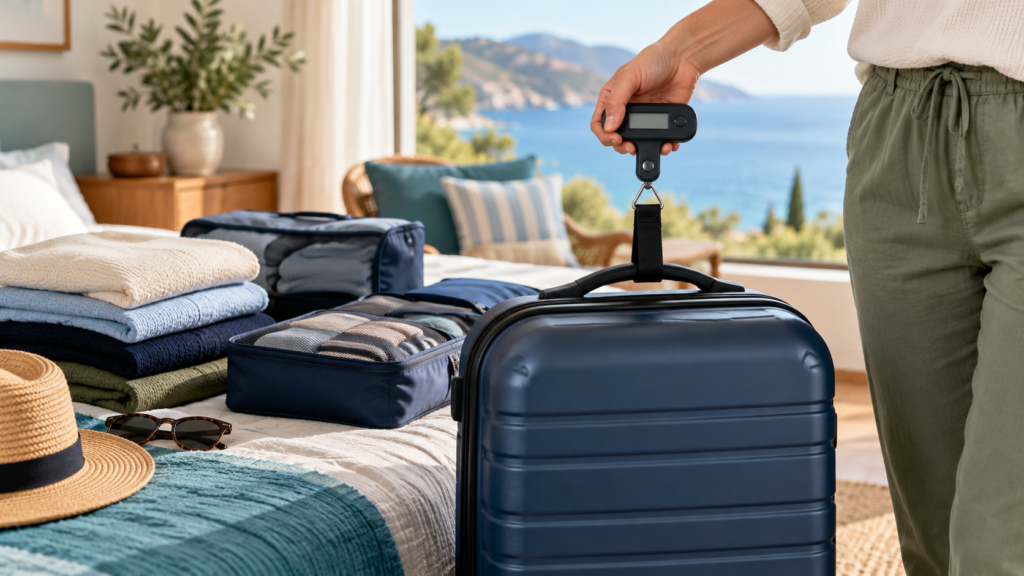
Best Luggage Scales for Avoiding Carry-On Weight Surprises

Fact-checked: October 12, 2026. This is a specification-based comparison using current manufacturer pages. We did not hands-on test these scales, so we do not assign laboratory accuracy scores, durability ratings or invented user-test results. Availability and prices can change by country.
A portable luggage scale is useful when a trip includes strict cabin limits, regional airlines or a return flight after buying extra gear. The best model is not necessarily the one with the highest capacity: most current options already reach 50 kg / 110 lb. More useful differences are increments, stated accuracy, display, battery type, product weight and how easily the strap or hook fits a suitcase handle.
Quick picks
- Best all-round specification set: Etekcity EL11 — 50 kg capacity, 50 g increments, 136 g body and one CR2032 battery.
- Best rechargeable option: Travelon Transit Rechargeable — USB-C charging, backlit display, data lock and 50 kg capacity.
- Best compact hook design: Heys xScale Mini — 87 g, retractable hook, bright display and two CR2032 batteries.
- Best for replaceable AAA batteries: Heys xScale Pro II — 94 g, backlit display and two AAA batteries.
These labels compare published specifications and use cases, not firsthand performance.
Comparison table
| Model | Capacity | Published increment or accuracy | Power | Product weight | Useful distinction |
|---|---|---|---|---|---|
| Etekcity EL11 | 50 kg / 110 lb | 50 g / 0.1 lb increments | 1 × CR2032 | 136 g | Fine display increments and temperature readout |
| Travelon Transit Rechargeable | 50 kg / 110 lb | Manufacturer describes high-precision sensing; no numeric tolerance published on page | USB-C rechargeable | Not stated on product page | 20-minute claimed recharge, backlight and data lock |
| Heys xScale Mini | 50 kg / 110 lb | Stated accuracy within 0.22 kg / 0.5 lb | 2 × CR2032 | 87 g | Retractable hook and compact cylindrical body |
| Heys xScale Pro II | 50 kg / 110 lb | Stated accuracy within 0.22 kg / 0.5 lb | 2 × AAA | 94 g | AAA batteries, backlight and rubberized grip |
Manufacturer increments and accuracy claims are not the same thing. An increment describes the smallest displayed step; accuracy describes how close a reading may be to the true value under stated conditions. We did not independently validate either.
1. Etekcity EL11: best all-round specification set
Etekcity lists a 50 kg / 110 lb capacity, 50 g / 0.1 lb increments, lb/kg switching, tare, automatic locking and a 120-second auto-off. The scale weighs 136 g and uses one CR2032 lithium battery.
The fine published increments are helpful when a cabin bag sits close to a limit. The trade-off is that a fine display does not guarantee the airport scale will agree. Leave a safety margin rather than packing exactly to the last displayed 50 g.
Best for: travelers who want clear published specifications and do not mind carrying a coin-cell spare.
Check before buying: regional availability, current price and whether the retailer supplies the same EL11 variant shown on the manufacturer page.
2. Travelon Transit Rechargeable: best rechargeable option
Travelon lists a 50 kg / 110 lb capacity, USB-C charging, a backlit LCD, data lock and automatic shutoff. The company says a full charge takes about 20 minutes. The current product page does not publish the item’s weight or a numeric accuracy tolerance.
Rechargeability can be convenient for a long trip, especially if the same USB-C cable already charges other accessories. It also creates a different failure mode: a flat built-in battery cannot be fixed instantly with a fresh coin cell.
Best for: travelers who prefer recharging over carrying disposable batteries.
Check before buying: included cable, warranty and the current return policy in your country.
3. Heys xScale Mini: best compact hook design
Heys lists the xScale Mini at 87 g and 10.5 × 4 × 4 cm. It has a retractable hook, bright LCD, automatic locking, auto-off and lb/kg display. Capacity is 50 kg / 110 lb, with manufacturer-stated accuracy within 0.22 kg / 0.5 lb. It uses two CR2032 batteries.
The retractable hook reduces loose webbing, but a hook must fit comfortably around the handle you plan to weigh. A two-handed strap design can feel easier with a heavy case, so handle geometry matters as much as the device’s own weight.
Best for: compact kits where a protected hook matters.
Check before buying: hook fit on your suitcase and stock in your destination market.
4. Heys xScale Pro II: best for AAA batteries
The xScale Pro II weighs 94 g and measures 15.2 × 3.5 × 2.2 cm. Heys lists a 50 kg / 110 lb capacity, backlit display, automatic locking and accuracy within 0.22 kg / 0.5 lb. It uses two AAA batteries rather than coin cells.
AAA batteries are easy to find in many destinations and can be swapped without charging. The model is longer than the xScale Mini, which may improve the grip for some users but consumes more pouch length.
Best for: travelers who want common replaceable batteries.
Check before buying: live regional price, color availability and whether the one-year limited warranty applies in your market.
What matters more than a 50 kg capacity
Most leisure luggage stays far below 50 kg. Prioritize:
- Repeatability: three readings should be close when the bag and technique are unchanged.
- Readable hold function: you should be able to set the bag down before reading the locked result.
- Comfortable grip: heavy checked luggage can be awkward to lift steadily.
- Units: confirm the scale is set to kg or lb before packing.
- Battery plan: carry a spare coin cell, use common AAA cells or recharge before departure.
- Your own packing margin: airline equipment remains the final authority.
How to check a luggage scale at home
This is a repeatability check, not laboratory calibration:
- Install or charge the battery and select the correct unit.
- Weigh the empty bag three times using the same handle and lifting motion.
- Add an object with a reasonably known mass, such as a labeled dumbbell, and repeat three times.
- Compare the spread between readings rather than trusting one result.
- If readings drift, replace or charge the battery and test again.
- Leave a buffer below the airline limit to account for technique and differences between scales.
Do not use a luggage scale for commercial, medical or safety-critical measurements. The airline’s check-in scale determines the accepted bag weight.
A better weighing technique
- Place the bag on the floor before attaching the strap or hook.
- Center the attachment on the main handle.
- Lift smoothly with both legs and keep the scale level.
- Hold still until the reading locks.
- Set the bag down before reading if the display remains locked.
- Repeat at least twice.
If lifting a heavy case is unsafe, divide the contents or ask another adult for help. A small handheld scale still requires the entire bag to leave the ground.
Digital versus mechanical scales
Digital scales usually offer a locked display, unit switching and a compact body. They need power and can show low-battery drift or fail when the battery is flat. Mechanical scales avoid batteries but may be harder to read and bulkier at similar capacities.
For most digital nomads, a simple digital model is easier to pack. The decision is mainly between coin-cell, AAA and rechargeable power.
Common mistakes
- Treating a 50 g display increment as guaranteed 50 g accuracy.
- Packing exactly to the airline limit with no buffer.
- Forgetting to switch from pounds to kilograms.
- Testing only once or lifting at an angle.
- Leaving the scale at home on the return journey.
- Buying from a marketplace listing that does not match the manufacturer’s model number.
For the rest of your setup, see our best suitcases for digital nomads, packing-cube guide and portable tech-pouch comparison.
Frequently asked questions
Are luggage scales accurate enough for flights?
They are useful for planning, but agreement with an airline scale is not guaranteed. Repeat the reading and leave a safety margin.
What capacity do I need?
A 50 kg / 110 lb capacity covers typical cabin and checked baggage limits. Comfort and repeatability are usually more important than additional capacity.
Is rechargeable better than replaceable batteries?
Rechargeable models reduce disposable batteries and can use a travel cable. Replaceable cells can be swapped immediately. Choose the failure mode that is easier for your trips.
How much margin should I leave?
There is no universal number because scales and airline limits vary. Leave enough buffer for repeat-reading variation and anything added before check-in.
Can I weigh a carry-on with a bathroom scale?
Often, by weighing yourself with and without the bag and subtracting. A luggage scale is more portable and usually easier for return trips.
Sources and methodology
Checked October 12, 2026:
- Etekcity EL11 product page
- Travelon Transit Rechargeable Luggage Scale
- Heys xScale Mini
- Heys xScale Pro II
- Travelon Digital Luggage Scale
Selection is based on published capacity, power, display, dimensions, weight and availability. We did not receive products, perform reference-weight testing or use affiliate tracking links.












Responses