

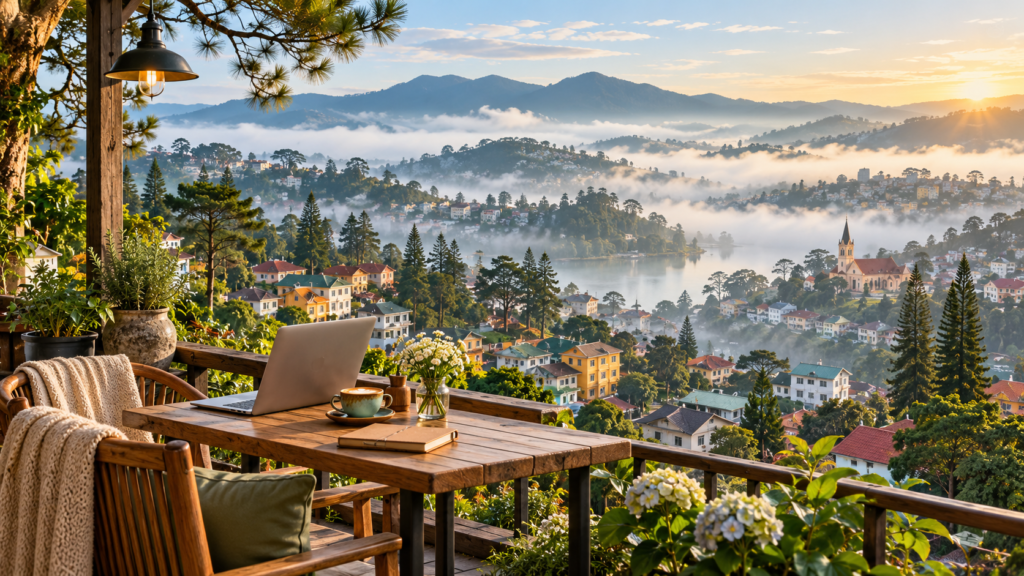
Da Lat, Vietnam: Digital Nomad Guide

Last fact-checked: October 10, 2026. Prices are transparent planning allowances in Vietnamese dong (VND), not citywide averages or guaranteed quotes. The USD equivalents use the State Bank of Vietnam reference rate of VND 25,629 per USD published on October 9, 2026. This guide does not claim a firsthand stay.
Da Lat is a cool-climate alternative to Vietnam’s coastal remote-work bases. Pine-covered hills, a compact central lake and a strong cafe culture can support a slower routine, but the city’s wet season, hills and limited coworking inventory require more planning than the postcard suggests.
Da Lat at a glance
| Quick fact | Planning answer |
|---|---|
| Best fit | Remote workers who value cool weather, cafes and a smaller-city rhythm |
| Main areas | Central Da Lat, Ward 2, the lake area and quieter hills outside the core |
| Currency | Vietnamese dong (VND) |
| Time zone | Indochina Time, UTC+7 year-round |
| Airport | Lien Khuong, about 30 km south of the city according to Vietnam Tourism |
| Planning budget | VND 22,500,000 per month for one person in a furnished-stay scenario |
Is Da Lat good for digital nomads?
Da Lat suits people who want milder temperatures and do not need a dense corporate network. Official Vietnam Tourism material describes the city as a cooler Central Highlands destination and identifies coffee, farming, lakes and outdoor activities as core attractions. It also warns visitors to pack a jacket from November to January and an umbrella during the April-to-November rainy period.
The trade-offs are a smaller supply of dedicated workspaces, steep roads and highly variable accommodation. A scenic room is not automatically a productive room. Verify a desk, chair, router, noise level, hot water and mould before paying for a month.
Internet and workspaces
Do not treat a booking site’s “Wi-Fi” badge as a speed guarantee. Ask the host for a recent test from the exact room at the time of day you normally work. Confirm whether the router is inside the unit or shared across a building, and carry a local SIM or eSIM for failover.
ThomWork currently markets itself as a dedicated Da Lat coworking space with ergonomic desks, a silent workspace, a cafe downstairs and opening hours from 8am to midnight. Its own site says no booking is needed. Verify prices, call-room availability and any after-hours conditions immediately before arrival.
One More Cafe has long been associated with an upstairs coworking area, but current details appear mostly on third-party listings rather than a stable first-party tariff page. Treat it as a venue to contact, not a guaranteed free office.
For the budget below, the VND 1,500,000 work-and-connectivity line is an editorial allowance covering coworking or cafe spending plus mobile data. It is not a quoted membership.
Where to stay
Central Da Lat and the lake area
The center reduces the need for a scooter and keeps restaurants, cafes and the market close. The trade-off is traffic, tourism noise and higher weekend demand. Check the precise hill gradient rather than measuring distance on a flat map.
Ward 2 and nearby residential streets
These areas can balance access to the center with a quieter residential setting. A room one kilometre from the lake may still involve a steep walk. Inspect drainage and natural light during the rainy season.
Hills outside the core
Outlying villas and homestays offer space and views but can increase transport costs and isolation. Confirm road access after dark, delivery coverage and the reliability of both power and internet.
Housing checklist
Before paying a deposit, request:
- a video call from the exact room;
- a recent Wi-Fi test and router location;
- a photo of the desk and chair;
- confirmation of hot water and heating or dehumidification;
- an itemised total including electricity, water, cleaning and deposit;
- cancellation and early-departure terms;
- noise information for construction, dogs, karaoke and road traffic.
Da Lat’s cool, damp periods make ventilation and moisture as important as room size. Never transfer a deposit solely on the basis of attractive exterior photos.
Monthly cost of living: VND 22,500,000 scenario
This model is for one person renting a furnished private room or small apartment, using a mix of coworking and cafes, eating mostly local food and using taxis or ride-hailing selectively. It excludes flights, major medical expenses, taxes and large visa-related costs.
| Category | VND/month | Assumption |
|---|---|---|
| Furnished accommodation | 10,000,000 | Editorial short-stay allowance; quote exact dates |
| Coworking, cafes and mobile data | 1,500,000 | Mixed workspace and connectivity allowance |
| Food and groceries | 5,500,000 | Local meals plus groceries |
| Local transport | 1,500,000 | Walking plus ride-hailing or taxi budget |
| Utilities and laundry | 800,000 | Where not included |
| Insurance and health | 900,000 | Personal placeholder; obtain quotes |
| Leisure and fitness | 1,300,000 | Modest activities budget |
| Miscellaneous | 1,000,000 | Household and personal buffer |
| Total | 22,500,000 | One-person planning scenario |
At the October 9 reference rate, VND 22,500,000 is about USD 878. This is a currency conversion, not a claim that every person can reproduce the budget. Bank, card and cash-exchange rates include spreads and fees.
Transport and airport access
Vietnam Tourism states that Lien Khuong Airport is about 30 km south of Da Lat and connects to major hubs. Airports Corporation of Vietnam reported that upgraded runway infrastructure returned to operation on August 19, 2026, and current ACV pages should be checked for flight changes.
Within the center, walking works for short trips, but hills and rain change travel time. Taxis and ride-hailing are easier than renting a scooter for many visitors. Do not ride without the correct licence, insurance and protective equipment. A home outside the core can make a scooter feel necessary, which should be priced into both budget and risk.
Da Lat’s heritage railway does not connect to Vietnam’s north–south main line; official tourism material presents it as a local attraction toward Trai Mat rather than intercity transport.
Weather and seasonal planning
The cooler climate is a major attraction. It can also mean cold evenings, wet clothes and damp rooms. Official Vietnam Tourism guidance identifies April through November as the rainy period and recommends warmer clothing from November through January.
For remote work, rain has three practical effects: slower road trips, more pressure on indoor cafe seating and a greater need for dry storage. A dehumidifier or well-ventilated room may be worth more than an extra balcony.
Cafe work etiquette
Da Lat has many cafes, but coffee quality and laptop suitability are separate questions. Ask before settling in, avoid video calls in quiet rooms, order again during a longer stay and move when meal service becomes busy. A cafe does not guarantee confidential calls, ergonomic seating or backup internet.
Use coworking for client calls, large uploads and hard deadlines. Use cafes for writing, reading and short administrative blocks.
Visa and legal stay
Vietnam’s Immigration Department states that the official e-visa portals are evisa.gov.vn and thithucdientu.gov.vn. Eligibility, permitted length, entry points and fees depend on the applicant and current rules. Use the official portal, not an intermediary that resembles it.
An e-visa or tourist permission is not a general authorisation for local employment. Remote workers should confirm the immigration, tax and work implications of their individual activities with the relevant Vietnamese authority or qualified adviser. Do not assume that being paid abroad resolves every legal question.
Health, safety and practical risks
Da Lat’s elevation and winding roads can affect people differently. Choose transport conservatively in rain and avoid combining unfamiliar roads with poor visibility. Keep travel insurance details accessible and identify a suitable clinic before needing one.
Normal city precautions apply: secure phones and bags, use reputable transport, protect accounts with multi-factor authentication and avoid sensitive work on open Wi-Fi.
Food and daily life
The surrounding highlands supply vegetables, fruit and coffee, and official tourism material highlights the area’s farms and coffee culture. The city is easy for casual local meals, while imported products and specialty diets can raise costs quickly.
The budget assumes VND 5,500,000 for food and groceries. Someone cooking often may spend less; frequent delivery, western restaurants and specialty coffee will raise the number.
Time zones and remote-work fit
Da Lat uses UTC+7 year-round. That aligns well with Southeast Asian teams and can overlap with Australia. European collaboration tends to fall in the afternoon and evening. North American calls can require early mornings or late nights.
Before booking accommodation, test how your actual meeting calendar fits the neighbourhood’s evening noise and the building’s shared spaces.
Final verdict
Da Lat is a strong choice for remote workers who want cool weather, highland scenery and a cafe-rich smaller city. It is less suitable for people who need multiple premium coworking options, flat terrain or a dense business network.
A transparent starting budget is VND 22,500,000 per month for one person, with accommodation as the biggest uncertainty. Compare this guide with our Da Nang digital nomad guide and the city guide directory before choosing a Vietnam base.
Frequently asked questions
How much does one month in Da Lat cost?
Our explicit one-person scenario totals VND 22,500,000, about USD 878 at the October 9, 2026 reference rate. It is a planning model, not a citywide average.
Does Da Lat have coworking?
Yes. ThomWork currently advertises a dedicated workspace with long daily hours. Confirm current prices and facilities directly before relying on it.
Is Da Lat colder than coastal Vietnam?
Yes. Its highland setting produces cooler conditions, and official tourism guidance recommends a jacket from November to January.
Sources
Da Lat Monthly Budget: VND 22,500,000 (Illustrative)
One adult, one month. Planning allowances, not live quotes. See the budget assumptions in the main guide.




Responses