

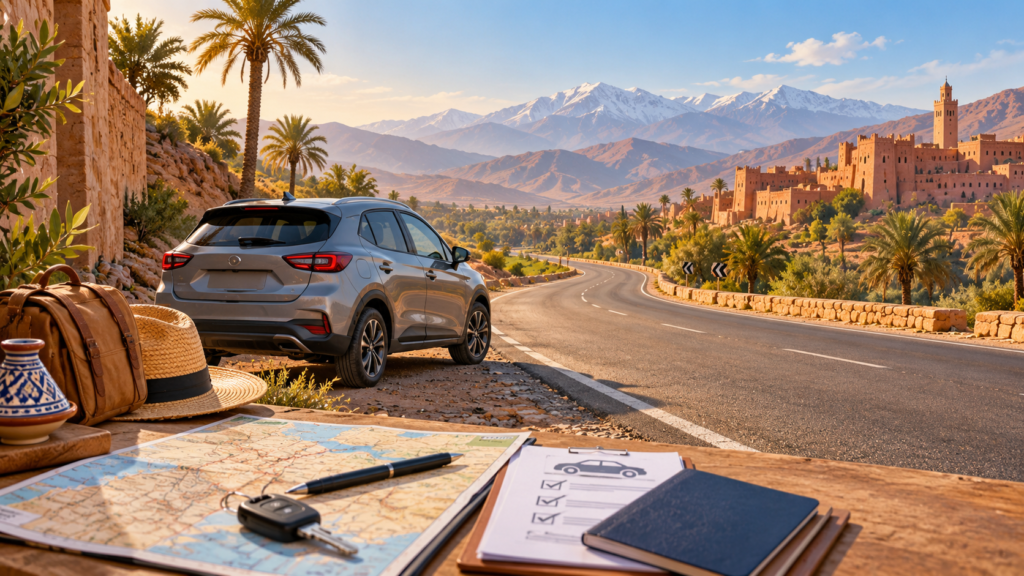
Renting a Car in Morocco: Deposits, Insurance and Total Cost

Renting a car in Morocco can make sense for routes through the Atlas Mountains, the Atlantic coast or smaller towns that are awkward to connect by train. The difficult part is not finding an advertised daily rate. It is understanding the deposit, payment-card rules, insurance excess and charges that appear around the base price.
This guide uses government travel advice and current operator information checked on 23 September 2026. It does not replace the rental agreement or nationality-specific driving rules. Prices and deposit amounts vary by company, location, vehicle and rate plan, so the method below shows how to calculate total cost without inventing a universal daily price.
The short version
- Bring your physical licence, passport and any International Driving Permit required for your nationality.
- Read the local station’s payment-card rules before booking. A debit card may not be accepted for the security authorization.
- Treat the security deposit and the insurance excess as two different numbers.
- Photograph every panel, wheel, tyre, window and the fuel gauge before leaving.
- Add protection, one-way, additional-driver, equipment, fuel, toll and parking costs to the base rate.
- Keep the signed condition report and final receipt until the deposit authorization disappears.
Licence and document requirements
Requirements depend on where your licence was issued and the rental company. UK government travel advice says British visitors should carry both their UK driving licence and the 1968 version of the International Driving Permit. It says Morocco no longer accepts the 1949 IDP for this purpose. Travellers from other countries should check their own government’s Morocco guidance and the operator’s rental information.
The same government guidance notes that hire companies can impose stricter rules, including a minimum period of driving experience and a higher minimum age. Your booking voucher should therefore be checked even if your licence is legally valid for driving.
At pickup, expect to show:
- the original physical driving licence;
- passport or accepted identity document;
- required IDP, where applicable;
- payment card in the lead driver’s name;
- booking confirmation;
- details for every additional driver.
Screenshots or photocopies may not be accepted. If your licence does not use the Latin alphabet, ask the operator in writing what translation or permit it requires.
Age, licence history and payment cards
Operator rules are not identical. SIXT’s Morocco page, for example, states a minimum rental age of 21 and says the licence must have been held for at least two years. It notes that some categories have higher minimum ages and that an extra charge applies to some drivers under 23.
The same page says major credit cards are accepted while prepaid and debit cards are not. That is a SIXT rule, not a statement about every rental company in Morocco. A local company may have different requirements, but you should never assume that a debit card used for online prepayment will also be accepted for the counter deposit.
Before booking, ask the exact station:
- Which card networks are accepted?
- Must the card be a credit card in the lead driver’s name?
- What available credit is needed for the deposit authorization?
- How long can the authorization remain after return?
- Are virtual, prepaid or debit cards refused?
Source: SIXT Morocco rental information.
Deposit versus insurance excess
These terms are often confused.
Security deposit: an amount blocked on a card or collected to cover potential charges. It affects available credit but is not an expected rental expense if the car is returned under the agreement.
Insurance excess or deductible: the amount for which the renter can remain responsible after covered damage or theft. Buying an excess-reduction product may lower this exposure, but exclusions can remain.
The deposit is not automatically equal to the excess. Ask for both figures in the same currency and request the terms in writing. Also ask whether the deposit changes if you buy the operator’s protection package.
Avoid publishing or relying on a generic “Morocco deposit” number. A compact car at a city office can have different authorization rules from an SUV at an airport, even under the same brand.
What insurance may and may not cover
A base rate normally includes the legally required cover and may include collision or theft protection with an excess. The labels and exclusions vary by contract. Optional packages can reduce the excess, but “full protection” is not a universal legal term.
Read the exclusions for:
- tyres, wheels and wheel covers;
- glass, mirrors and lights;
- roof and underbody;
- clutch or mechanical damage attributed to misuse;
- lost keys and documents;
- wrong fuel;
- towing and roadside assistance;
- driving on prohibited or unpaved roads;
- damage when an unauthorized driver is operating the car;
- failure to obtain a police or accident report.
Credit-card rental cover or third-party excess insurance may reimburse a claim rather than eliminate the counter deposit. Confirm the country, vehicle class, rental length and road exclusions with the insurer before relying on it.
SIXT states that its additional protection packages are optional and are intended to reduce liability. Always compare the remaining excess and exclusions, not just the package name.
A transparent total-cost formula
Calculate two totals:
Expected trip cost
Base rental + mandatory taxes and station fees + protection + additional driver + one-way fee + equipment + fuel + tolls + parking + cleaning or late-return charges
Cash or credit required
Prepaid amount + counter payment + refundable security authorization
The deposit belongs in the second total, not the first, unless some or all of it is retained.
Illustrative example
Suppose a seven-day booking shows a base rate of €210. The checkout adds €45 of mandatory charges, €84 of excess reduction and €35 for an additional driver. You budget €70 for fuel, tolls and parking. The expected trip cost is €444.
If the operator also authorizes a €1,000 security deposit, you need enough card capacity for €1,444 even though the expected spend is €444. These figures demonstrate the method only; they are not a quote for Morocco or any rental company.
Charges to check before payment
Airport or location fee
An airport pickup can be convenient but may carry a location surcharge. Compare the final total with a city office only after adding transport to that office and its opening hours.
One-way fee
Returning the car in another city can add a charge or require prior approval. SIXT says domestic one-way rentals may be allowed depending on the rate, with an additional fee. Confirm the exact route rather than assuming every station pair is permitted.
Additional driver
Every person who may drive should be listed. An unregistered driver can create a serious coverage problem after an accident.
Young-driver fee
The age threshold and affected vehicle groups vary. Check the lead driver and every additional driver.
Equipment
Child seats, navigation units and Wi-Fi devices can be charged per day and may be capped. Reserve essential equipment in advance but confirm availability.
Fuel policy
Full-to-full is easiest to audit when the pickup and return gauges are documented. If the policy is different, calculate the service charge as well as the fuel value.
Tolls and parking
Ask whether tolls are paid directly and whether the rental company adds an administration fee for later charges. Keep receipts when practical.
Pickup inspection checklist
Do the inspection before moving the car and while there is enough light.
- Photograph a slow walk around the vehicle with the station visible.
- Take close photos of existing scratches, dents and paint chips.
- Photograph every wheel and tyre, including the spare or repair kit.
- Record windscreen, mirrors, lights, roof and lower bumpers.
- Photograph the odometer and fuel level.
- Confirm the contract lists every existing mark.
- Test lights, indicators, wipers, air-conditioning and locks.
- Check that registration, insurance and accident forms are in the car.
- Ask which phone number to use after a breakdown or collision.
- Save the photos outside your phone in case it is lost.
Do not accept “we already know about it” as a substitute for a written condition record.
Driving conditions and accidents
UK government guidance advises extra attention to pedestrians, animals and poorly lit roads at night. It says secondary and mountain roads can become hazardous in bad weather, and road accidents are frequent.
If an accident occurs, follow the rental company’s emergency process immediately. The government guidance refers to a constat amiable, an accident form signed by both parties for applicable collisions. A rental agreement may also require police documentation. Do not agree privately to a payment or leave the scene without understanding the legal and insurance process.
Morocco applies strict drink-driving rules. The government guidance warns that any alcohol detected can lead to a fine and possible imprisonment. The practical rule is simple: do not drink and drive.
Cross-border and road restrictions
Never assume a Moroccan rental can be taken into another country or onto every desert track. SIXT says its Morocco rentals cannot be driven into neighbouring countries. Other companies can set their own restrictions.
Check the contract before driving on:
- unpaved or desert roads;
- high mountain routes in poor weather;
- ferries;
- border routes;
- roads closed by authorities.
An SUV does not automatically include permission for off-road use.
Return process
Return during staffed hours when possible and ask an employee to inspect the car. Photograph the same panels, wheels, odometer and fuel gauge again. Obtain a signed return document and final receipt.
If you must use a key drop, the rental can remain open until staff inspect the car. Read who bears risk during that interval and take time-stamped photos at the approved parking location.
Monitor the security authorization after return. If it remains longer than the stated period, contact both the rental company and card issuer with the closed agreement.
When a rental car is worth it
A car is most useful for multi-stop routes, rural accommodation and places poorly served by rail. It is less attractive for a stay focused on central Marrakesh, Casablanca or Tangier, where parking and city traffic can outweigh the flexibility.
Use our Marrakesh guide and Tangier guide to compare a city-based stay with a road-trip itinerary before booking a vehicle for the entire month.
Bottom line
The correct way to compare Morocco car rentals is to ignore the daily-rate headline and build a complete, written cost sheet. Verify the licence and card requirements, separate the deposit from the excess, inspect the vehicle carefully and keep the contract until the authorization is released.
A cheaper prepaid rate is not a saving if the card is refused at pickup or the insurance leaves an excess you did not budget for.
Frequently asked questions
Do I need an International Driving Permit in Morocco?
It depends on the issuing country and current rules. UK guidance says British visitors need the 1968 IDP together with their UK licence. Other travellers should check their own authority and rental company.
Can I rent a car in Morocco with a debit card?
Policies vary. SIXT’s Morocco page says debit and prepaid cards are not accepted. Confirm the exact pickup station before booking elsewhere.
Is the security deposit part of the rental price?
It is normally a temporary authorization rather than an expected expense, but it reduces available credit and can be used for valid post-rental charges.
Does full insurance remove every risk?
Not necessarily. Tyres, glass, roof, underbody, keys, wrong fuel, prohibited roads and unauthorized drivers may remain excluded. Read the contract.
Can I drive a Moroccan rental into another country?
Do not assume so. SIXT prohibits taking its Morocco rentals into neighbouring countries. Other companies may impose similar or different restrictions.









Responses