

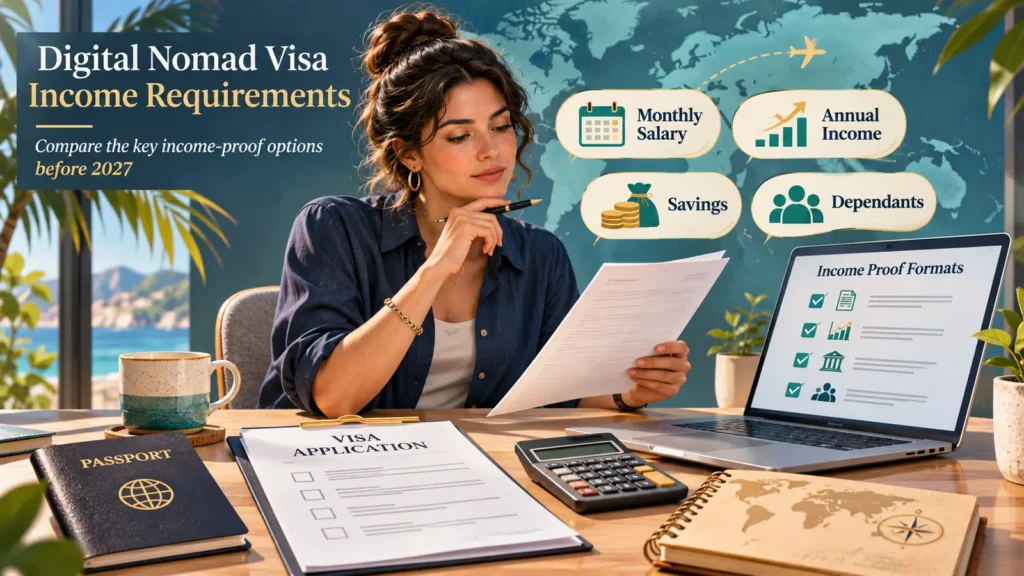
Digital Nomad Visa Income Requirements: What to Check Before 2027
Digital nomad visa income requirements are not a single number. One programme may use gross annual income, another a monthly net-salary multiple, and another a national minimum-wage formula that changes without the visa page being rewritten. Proof periods, dependants and acceptable documents can matter as much as the headline threshold.
This guide compares official rules available on 5 November 2026 for Slovenia, Croatia, Spain, Malta and Malaysia. It does not predict 2027 thresholds and is not legal advice. Recheck the official application page immediately before applying.
What changed, and what did not
The most important late-2026 development in this sample is Malaysia’s transition to an enhanced DE Rantau framework. MDEC announced on 29 October 2026 that new applications are closed from 1 to 30 November 2026 and are due to resume on 1 December under the enhanced framework. That makes an older income screenshot or blog post especially unreliable.
Elsewhere, the main risk is automatic indexation. Croatia publishes a euro amount based on the previous year’s average net salary. Slovenia uses a salary-linked formula. Spain uses a percentage of the statutory minimum wage. Those inputs can change, so a number copied in 2026 may be wrong for an application filed in 2027.
Current official examples, checked 5 November 2026
| Programme | Published income or funds rule | Proof detail that changes the calculation |
|---|---|---|
| Slovenia digital nomad permit | Monthly funds of at least twice Slovenia’s average monthly net salary | The official page uses a salary-linked formula rather than a fixed permanent euro figure and allows proof from lawful income sources |
| Croatia temporary stay for digital nomads | Currently €3,622.50 per month, or €43,470 available for a 12-month stay; €65,205 for 18 months | Regular-income proof can use a bank statement or at least six months of payslips; each additional family member increases the rule by 10% of the average monthly net salary |
| Spain international teleworker visa | 200% of the monthly statutory minimum wage, known as the SMI | The first accompanying family member adds 75% of SMI and each additional member adds 25%; the official page allows several forms of evidence |
| Malta Nomad Residence Permit | €42,000 minimum gross yearly income | The official FAQ says the applicant must show a guaranteed source of income for at least five cumulative months from application |
| Malaysia DE Rantau Nomad Pass | The current MDEC programme page lists more than US$36,000 per year for tech talent/professions | New applications are temporarily closed during November 2026 and resume under an enhanced framework, so verify the reopened rules rather than using an older FAQ |
These rows are not directly comparable. Malta labels its test as gross annual income. Croatia describes means of subsistence and allows either regular monthly proof or a lump sum. Spain ties the threshold to a statutory wage. Slovenia uses a salary formula. Malaysia separates profession categories and is in an announced transition period.
1. Confirm whether the figure is gross, net or available funds
Do not convert every threshold into a salary target.
- Gross income is measured before income tax and other deductions. Malta expressly uses gross yearly income.
- Net-income formulas use take-home salary statistics as the reference. Croatia’s digital-nomad rule is 2.5 times the previous year’s average monthly net salary.
- Means of subsistence may be proved through income, savings or both, depending on the programme. Croatia publishes monthly and lump-sum alternatives.
- Minimum-wage multiples move when the underlying statutory wage moves. Spain asks for 200% of SMI for the main applicant.
If the official page is ambiguous, do not relabel the number. Ask the responsible authority whether your contract value, payslip gross, bank deposit or post-tax income is the relevant measure.
2. Recalculate for dependants
A threshold for one applicant is not automatically a family threshold.
Croatia adds 10% of the official average monthly net salary for each additional family member or recognised partner. Spain’s official page asks for an additional 75% of SMI for the first accompanying family member and 25% for each additional member. Other programmes may instead assess whether the main income remains sufficient without publishing the same formula.
Write the calculation out before collecting evidence:
- main-applicant requirement;
- spouse or first dependant addition;
- each further dependant addition;
- the required proof period; and
- a buffer for exchange-rate movement if your income is in another currency.
Do not round down to the threshold. Bank conversion methods, payment timing and document review can make a borderline application harder to assess.
3. Check the proof period, not only the latest payslip
Programmes often want a pattern, not a one-day balance.
Croatia accepts a bank statement showing the full required amount, a statement showing regular income, or payslips for at least six months at the required level. Malta’s April 2026 FAQ says applicants must prove a guaranteed source of qualifying income for at least five cumulative months from the application date. MDEC’s current remote-worker document checklist asks for recent bank statements and matching income evidence, while its programme rules also require an active foreign work relationship.
A high balance without matching employment or client evidence may not answer a programme’s purpose test. Conversely, a strong contract may not be enough if the application also asks for deposited income over several months.
4. Match names, currencies and payment records
Build one evidence trail that a case officer can follow:
- contract or client agreement;
- invoices or payslips;
- bank deposits matching those documents;
- tax or income statements where requested;
- employer confirmation of remote work;
- exchange-rate method and date for foreign-currency income; and
- certified translations where required.
MDEC’s mandatory-document notes say names and income details should be consistent across documents and that files must be in English or accompanied by certified English translations. That is a useful standard even where another programme does not spell it out in the same way.
Avoid making your own optimistic currency conversion. If the authority does not publish a conversion method, retain evidence of the rate used and leave a margin above the threshold.
5. Separate income eligibility from remote-work eligibility
Meeting the money test does not make every remote worker eligible.
Slovenia defines a digital nomad as a non-EU/EEA foreigner working remotely for a business entity based outside Slovenia or as a self-employed person abroad, without entering the Slovenian labour market. Croatia similarly requires remote work for a foreign employer or a foreign-owned business and excludes services to Croatian employers. Malta requires foreign employment, foreign self-employment or foreign clients and excludes work for Malta-based companies or individuals.
The employer, client and company location therefore matter alongside income. A local customer, a local subsidiary relationship or an in-country employment arrangement can change the correct permit route.
6. Watch for index-linked thresholds
Three common update mechanisms appear in the official examples:
A fixed figure that can be revised
Malta currently publishes €42,000 gross annually. It previously used €32,400 for applications made before 1 April 2024. A fixed figure can still change through a programme update.
A salary or wage formula
Slovenia uses at least twice the average monthly net salary. Spain uses 200% of SMI. The underlying official statistic can change even if the wording of the formula stays the same.
An annually recalculated amount
Croatia currently publishes €3,622.50 per month, based on 2.5 times the 2025 average monthly net salary of €1,449. The Croatian authority can publish a new amount when the reference-year statistic changes.
For an application planned in early 2027, check the official page again after any new salary, minimum-wage or programme announcement.
7. Treat announced 2027 changes carefully
An announcement is not permission to invent the final application rules.
MDEC’s 29 October 2026 notice confirms an enhanced DE Rantau framework effective 1 December 2026, a temporary closure for new applications during November and a renewal pathway of up to four years, subject to continued eligibility and approval. It also directs applicants to the enhanced framework materials. If the reopened application form, FAQ and programme page differ from an older document, use the current official application materials.
The same discipline applies elsewhere. A proposal, budget speech or news report may signal a change without supplying the final threshold, evidence rules or effective date. Label proposals as proposals and wait for the responsible authority’s published instructions.
A pre-application income checklist
Before applying for any digital nomad visa or residence permit, record:
- the official programme URL and the date checked;
- whether the rule is gross, net, revenue or available funds;
- monthly versus annual measurement;
- the currency and accepted conversion method;
- the required history of payslips, deposits, contracts or tax returns;
- dependant additions;
- whether savings can replace regular income;
- whether multiple clients or income sources can be combined;
- whether the employer and clients must be outside the destination;
- whether documents require translation, legalisation or certification;
- whether the programme is accepting new applications; and
- the date on which any announced change becomes effective.
Keep a dated PDF or screenshot of the official requirement used for your calculation. It will not override the law or current application rules, but it helps you explain which published guidance you followed.
Common mistakes
Using a search-result number as the final rule
Search snippets and comparison sites become stale. Open the authority’s current application page and document checklist.
Mixing gross and net income
A gross salary can exceed a net threshold numerically without proving that the required net amount reaches your account. Use the category the programme names.
Ignoring dependants
Family additions can materially change the required funds. Calculate the complete household before applying.
Showing a balance without a source
Some programmes accept savings, while others focus on an ongoing remote-work relationship. Provide the contract, income record and bank trail the checklist requests.
Assuming a 2026 figure remains valid in 2027
Salary-linked and minimum-wage-linked rules can move. Recheck close to submission.
Frequently asked questions
Which digital nomad visa has the lowest income requirement?
There is no reliable answer without fixing the applicant type, date, family size and proof method. A lower headline number may use net income, exclude dependants or require a longer history. Compare complete rules rather than one figure.
Can savings replace monthly income?
Sometimes. Croatia explicitly publishes a lump-sum alternative for the intended stay. Other programmes may require guaranteed income or an active contract. Use the exact official proof rule.
Do freelance invoices count?
They can, where the programme accepts freelance or self-employed applicants, but invoices may need matching contracts, bank deposits and tax records. An invoice alone does not prove payment.
What if my income is in another currency?
Keep a documented exchange-rate method, use the date or period required by the authority and retain a buffer. Do not relabel a local-currency rule as dollars or euros.
Will thresholds rise in 2027?
They may, particularly where a formula follows wages or salary statistics, but this article does not forecast changes. Check the responsible authority immediately before submitting.
Sources and methodology
Official sources were checked on 5 November 2026. The comparison records published rules and does not assess an individual’s eligibility.
- Slovenian Ministry of the Interior: temporary residence permit for digital nomads
- Croatian Ministry of the Interior: temporary stay of digital nomads
- Spain Plataforma ONE: digital nomad visa application
- Residency Malta: Nomad Residence Permit FAQ, version 14.1
- MDEC: Digital Nomad Pass programme
- MDEC: enhanced DE Rantau framework and temporary closure notice, 29 October 2026




Responses