

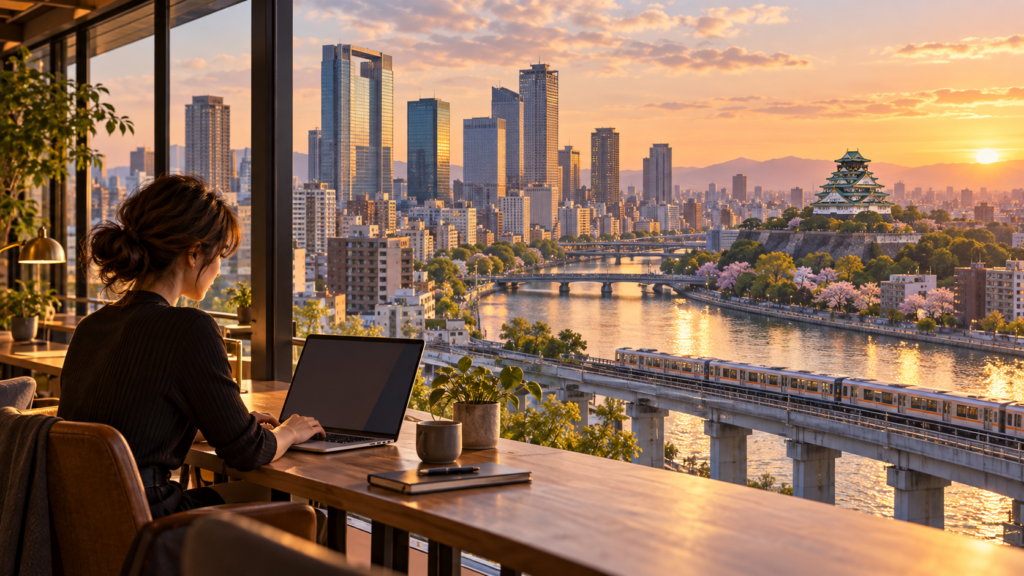
Osaka, Japan: Digital Nomad Guide

Last fact-checked: October 5, 2026. Prices below are explicit planning assumptions in Japanese yen (JPY), not guarantees or citywide averages. This guide is based on official and current provider information and does not claim a firsthand stay.
Osaka at a glance
Osaka is a practical Japanese base for remote workers who want dense city life, excellent rail connections and a lower-pressure rhythm than central Tokyo. The core choice is less “which city?” than “which side of Osaka?” Umeda is strongest for intercity rail and polished business infrastructure; Namba is stronger for nightlife, food and direct access to southern Osaka.
| Quick fact | Planning answer |
|---|---|
| Best fit | Remote workers who want a major Japanese city with strong regional transport |
| Main areas | Umeda, Namba, Honmachi, Tennoji and quieter residential districts |
| Currency | Japanese yen (JPY) |
| Time zone | Japan Standard Time, UTC+9 year-round |
| Planning budget | JPY 310,000/month for one person in a furnished private-stay scenario |
Is Osaka good for digital nomads?
Osaka works well when transport, food and everyday convenience matter more than a beach or a large English-speaking nomad scene. The subway network covers the main commercial districts, and rail links make Kyoto, Kobe and Nara realistic day trips.
The main weaknesses are housing friction and immigration limits. A monthly apartment advertised to local residents may involve a guarantor, key money, deposits, agency charges or a minimum contract that does not suit a visitor. A tourist entry status is not a blanket remote-work permission; eligible applicants should check Japan’s specific digital-nomad category.
Internet and coworking
Do not rely on a generic “Wi-Fi included” badge. Ask a host for a current speed test from the exact room, whether the router is shared, whether wired Ethernet is available and whether video calls remain stable during evening peak hours. Keep a Japanese SIM or eSIM as backup.
The DECK near Sakaisuji-Hommachi is a useful current price anchor. On October 5, 2026, its official page listed drop-in use at JPY 1,300 for under two hours and JPY 2,500 for a full day. It also listed one-month totals of JPY 26,500 for limited-hour access and JPY 31,000 for 24/7 access, while longer commitments reduced the monthly amount. Check taxes, registration, access hours and minimum term before paying.
Umeda vs Namba
Umeda
Choose Umeda if you expect frequent intercity travel, prefer large office buildings and want direct access to Osaka and Umeda stations. It is convenient for Kyoto and Kobe connections and has extensive shopping and dining. The trade-offs are busy pedestrian flows, complex station navigation and higher short-stay prices near the main transport hub.
Namba
Choose Namba for nightlife, food, entertainment and direct access toward Kansai Airport through Nankai services. It can be the livelier option after work, but street noise varies sharply block by block. Inspect the building entrance and late-night environment before committing.
Honmachi
Honmachi sits between Umeda and Namba and is a practical compromise for focused work. It has office infrastructure and direct metro connections without placing you in the busiest entertainment streets. The DECK’s Sakaisuji-Hommachi location makes this area especially convenient for a coworking-centered routine.
Tennoji and residential Osaka
Tennoji combines transport, shopping and access to southern neighborhoods. Areas farther from the central loop may offer more space, but only if the station-to-home walk and transfer pattern fit your daily routine.
Housing and booking constraints
Separate four markets before comparing prices: hotels, serviced apartments, furnished monthly rentals and ordinary residential leases. Headline rent on a normal Japanese lease is not the final cost for a one-month visitor.
Oakhouse’s Osaka monthly listings illustrate the problem. On October 5, 2026, its current search page showed no generally available Osaka monthly rooms, although individual property pages displayed example rents from roughly JPY 48,000 to JPY 80,000. Several were full. Treat these as dated examples, not promises of availability. Ask for the final payable total, minimum stay, cleaning charge, utilities, cancellation rules and whether a desk and private router are included.
For the budget below, JPY 130,000 is an editorial allowance for a private furnished stay, not a claim that a specific unit is available at that price.
Monthly cost of living: JPY 310,000 scenario
This model is for one person in a private furnished stay, using coworking, cooking some meals and relying on public transport. It excludes flights, deposits, taxes, major medical costs and one-time registration charges.
| Category | JPY/month | Assumption |
|---|---|---|
| Furnished accommodation | 130,000 | Editorial short-stay allowance; quote exact dates |
| Coworking | 30,000 | Near DECK’s one-month 24/7 total |
| Food and groceries | 55,000 | Mix of groceries and casual meals |
| Local transport | 15,000 | Pay-as-you-go metro and rail allowance |
| Utilities and mobile | 15,000 | Where not included |
| Insurance and health | 12,000 | Personal placeholder; obtain quotes |
| Leisure and fitness | 25,000 | Modest activities budget |
| Miscellaneous | 18,000 | Household and personal buffer |
| Visa and administration | 10,000 | Monthly planning buffer, not an official fee |
| Total | 310,000 | One-person planning scenario |
Transport
Osaka Metro prices journeys by distance. Its official fare page lists adult subway and New Tram fares of JPY 190 for the shortest zone, then JPY 240, 290, 340 and 390 across longer zones. Use an IC card for convenience, but remember that JR, private railways and the metro are different operators.
For airport access, compare the exact destination. Nankai services are convenient for Namba, while JR and bus options may fit Umeda or Tennoji better. Do not choose accommodation only from an “airport train” label; calculate door-to-door time with luggage.
Visa and legal stay
Japan’s Immigration Services Agency publishes a Designated Activities status for eligible digital nomads. It allows qualifying remote work for up to six months, is not extendable and does not issue a residence card. The official criteria include an eligible nationality, annual income of at least JPY 10 million and private medical travel insurance with at least JPY 10 million in medical-treatment coverage.
The category is for work performed remotely for a foreign organization or for clients outside Japan. It does not authorize employment by a Japanese organization. A spouse or child may qualify under a related category. Confirm the current nationality list, evidence and application route with the Japanese mission responsible for your residence.
Food, nightlife and daily rhythm
Osaka’s food reputation makes casual dining easy to find, but a working month still benefits from a kitchen and grocery routine. Namba and Dotonbori are convenient for nightlife; Umeda has broad dining and shopping; neighborhood shotengai shopping streets can support cheaper everyday purchases.
Late-night noise is highly local. Ask whether the bedroom faces a main road, railway or entertainment street. For calls with North America, quiet hours and wall insulation can matter more than proximity to a bar district.
Climate
Summers are hot and humid, while winter is cooler and generally drier. Spring and autumn are comfortable but popular. Budget for air-conditioning use and verify whether utilities are capped in a monthly rental.
Fitness, health and families
Parks and river paths support walking and running, while gyms may require registration, indoor shoes or a longer contract. Short-term visitors should confirm day-pass or month-to-month terms.
Families should check room size, elevator access, school or childcare arrangements and the distance to a hospital that can communicate in a useful language. Travel insurance and Japanese immigration insurance requirements are separate questions.
Time zones and remote-work fit
Japan Standard Time is UTC+9 year-round. It aligns naturally with East Asia and much of Australia. European calls often land in the evening; North American collaboration can require early mornings or late nights.
Final verdict
Osaka is a strong base for remote workers who value transport, food and a true big-city environment. Umeda suits frequent rail travel and business routines, while Namba suits nightlife and southern transport. Honmachi offers the most balanced working base.
A transparent one-person planning target is JPY 310,000 per month, but the furnished-stay quote is the largest swing factor. Compare our Tokyo guide and the city guide directory before choosing a Japanese base.
Frequently asked questions
Can digital nomads legally stay in Japan?
Eligible applicants can use Japan’s six-month Designated Activities category. Nationality, income, insurance and work-relationship rules apply. Tourist entry is a separate status.
Is Umeda or Namba better?
Umeda is better for business infrastructure and intercity rail. Namba is better for nightlife, food and access toward Kansai Airport. Honmachi is the balanced middle option.
What monthly budget should one person use?
Our explicit furnished-stay scenario totals JPY 310,000. It is a planning model, not a citywide average.
Sources
Osaka Monthly Budget: JPY 310,000 (Illustrative)
One adult, one month. Planning allowances, not live quotes. See the budget assumptions in the main guide.


Responses