

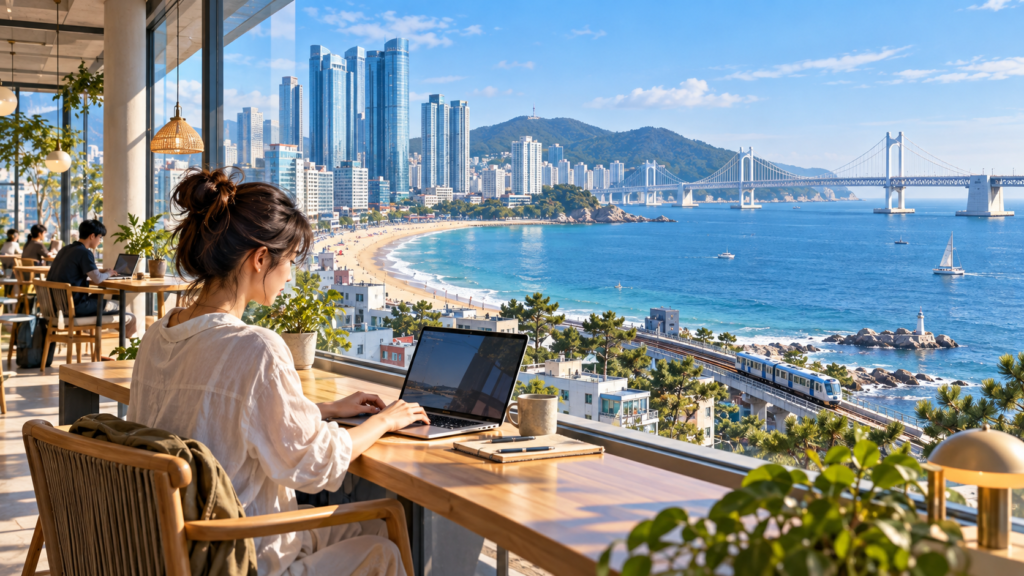
Busan, South Korea: Digital Nomad Guide

Last fact-checked: October 5, 2026. Prices below are explicit planning assumptions in South Korean won (KRW), not guarantees or citywide averages. This guide uses official current sources and does not claim a firsthand stay.
Busan at a glance
Busan offers a different remote-work base from Seoul: beaches, mountain edges and a large metro area with a lower-rise rhythm outside the central districts. The key decision is Seomyeon versus Haeundae. Seomyeon is the practical central transport hub; Haeundae provides the coastal lifestyle but adds time to cross-city trips.
| Quick fact | Planning answer |
|---|---|
| Best fit | Remote workers who want a major Korean city with beaches and metro access |
| Main areas | Seomyeon, Haeundae, Gwangan, Nampo and Songdo |
| Currency | South Korean won (KRW) |
| Time zone | Korea Standard Time, UTC+9 year-round |
| Planning budget | KRW 2,650,000/month for one person in a furnished private-stay scenario |
Is Busan good for digital nomads?
Busan works well for people who want urban infrastructure without living in Seoul. The city government is actively promoting workation programs and publishes support for accommodation, workspaces and tourism links. That does not mean every independent traveler automatically receives a subsidy; eligibility and booking routes must be checked.
The main challenges are distance and housing terms. Busan is spread along coast, mountains and river corridors. A low-priced room can become inconvenient if every meeting requires multiple transfers. Korean housing listings may also quote deposits separately from monthly rent.
Internet and workspaces
Korea’s general connectivity is strong, but a listing’s “Wi-Fi” badge does not prove that a specific room can handle uploads and calls. Request a recent wired and wireless speed test, confirm whether the router is private and keep a Korean SIM or eSIM for backup.
Busan’s official workation program lists hub and satellite workspaces, coworking, seminar rooms, book cafés and study cafés as part of the city’s offer. In April 2026 the city also announced a foreigner-friendly reservation partnership with Agoda for eligible workation participants. Treat program access, discounts and workspace use as application-dependent, not universal.
For the budget below, KRW 250,000 is an editorial coworking allowance rather than a claimed current membership price.
Seomyeon vs Haeundae
Seomyeon
Seomyeon is the best default for a first working month. Lines 1 and 2 intersect here, making it easier to reach Nampo, Haeundae and other districts. The area has restaurants, shops and late-night activity, so check noise and the precise walk to the station.
Choose Seomyeon if you expect meetings across the city or want transport efficiency. The trade-off is that it feels more commercial and less coastal.
Haeundae
Haeundae suits remote workers who want the beach, morning walks and a modern coastal environment. It also has a large hotel and serviced-apartment supply, though prices move with weekends, festivals and summer demand.
Choose Haeundae if the coastal routine is the main reason for coming. Skip it if you expect daily trips to the western side of Busan; cross-city travel adds up.
Gwangan and Suyeong
These areas can balance beach access with a more residential rhythm. They may suit travelers who want the coast without Haeundae’s largest visitor crowds. Check the exact station and hill gradient.
Nampo and Songdo
Nampo is useful for markets, the old center and southern port districts. Songdo offers a quieter coastal base. Busan opened the Hue & Work Seo-gu Workation Center in the Songdo Beach area in February 2026, but participation terms and accommodation support are program-specific.
Housing, deposits and monthly rentals
Korean housing prices are often shown as deposit/monthly rent. A listing written as “10 million / 800,000” is not an 800,000-won all-in monthly rental; it means a large refundable deposit plus rent, and may exclude maintenance fees and utilities.
Visitors comparing hotels, serviced apartments, residence-style rooms and local leases should request one final number for the intended dates. Ask about:
- deposit and refund timing;
- maintenance and utility charges;
- minimum term;
- cleaning fees;
- desk, chair and router;
- elevator and luggage access;
- cancellation and early departure.
The KRW 1,100,000 housing line below is a planning allowance for a private furnished stay, not an offer for a specific room.
Monthly cost of living: KRW 2,650,000 scenario
This model is for one person in a private furnished stay, using coworking, cooking some meals and relying on public transport. It excludes flights, major deposits, taxes and large medical expenses.
| Category | KRW/month | Assumption |
|---|---|---|
| Furnished accommodation | 1,100,000 | Editorial short-stay allowance; quote exact dates |
| Coworking | 250,000 | Planning allowance; verify selected space |
| Food and groceries | 500,000 | Mix of groceries and casual meals |
| Local transport | 80,000 | Metro and bus allowance |
| Utilities and mobile | 150,000 | Where not included |
| Insurance and health | 120,000 | Personal placeholder; obtain quotes |
| Leisure and fitness | 250,000 | Modest activities budget |
| Miscellaneous | 150,000 | Household and personal buffer |
| Visa and administration | 50,000 | Monthly planning buffer, not an official fee |
| Total | 2,650,000 | One-person planning scenario |
Transport
Busan Transportation Corporation uses two distance sections. Its official fare table, effective under the current rules, lists adult transit-card or mobile fares of KRW 1,600 for section 1 and KRW 1,800 for section 2. QR tickets cost KRW 1,700 and KRW 1,900.
The official mobile season-ticket table lists a one-month adult pass at KRW 45,000 for 45 one-way metro trips within 30 days. It does not cover buses, the Donghae Line or the Busan–Gimhae Light Rail. Compare it with pay-as-you-go use based on your actual route.
Visa and legal stay
South Korea formally moved the F-1-D digital-nomad/workation visa from pilot to permanent operation on June 30, 2026. The Ministry of Justice says the maximum stay was increased from two years to three.
The standard income threshold remains tied to twice the prior-year per-capita GNI, but the 2026 framework permits lower thresholds between one and two times GNI based on age and residence outside the capital region or in designated population-decline areas. The ministry gives the example of an applicant aged 18–34 living outside the capital region qualifying at one times GNI.
That framework is more nuanced than a single salary number. Applicants should confirm their exact age, location, employment history, insurance and document requirements with the Korean mission or immigration office responsible for their case. The visa is for remote work connected to overseas business or employment; it does not automatically authorize Korean employment.
Winter, summer and seasonal planning
Busan’s coastal winter is milder than inland Korea but can still be cold, windy and dry. Check whether the apartment has adequate heating and how utilities are billed. Summer is hot, humid and rainy, with typhoon disruption possible. Beach districts are busiest in warm months and around events.
For a working month, shoulder seasons can offer a better balance, but accommodation pricing still depends on weekends and festivals.
Food, nightlife and daily life
Seomyeon provides central nightlife and broad everyday shopping. Haeundae and Gwangan combine restaurants with coastal routines. Nampo and Jagalchi connect to traditional markets and the older center.
A food budget must reflect habits. Convenience stores and casual restaurants are easy to find, but imported groceries, specialty diets and frequent delivery can raise costs.
Fitness, health and families
Beach promenades and river paths support walking and running, while the hills add elevation quickly. Gyms may require registration or Korean-language contracts; confirm short-term access.
Families should verify stroller access, room size, childcare or school arrangements and proximity to an appropriate clinic. Private travel insurance, Korean national health-insurance rules and visa insurance evidence are separate issues.
Community and language
Busan’s foreign-resident and workation programs can help with orientation, but the city is not a single concentrated nomad district. Community depends on coworking, language exchange, hobby groups and the neighborhood chosen. Basic Korean improves daily tasks, especially leases and medical care.
Time zones and remote-work fit
Korea Standard Time is UTC+9 year-round. It fits East Asian and Australian teams. European collaboration tends to fall in the evening, while North American calls may require early mornings or late nights.
Final verdict
Busan is a strong alternative to Seoul for remote workers who value beaches and a large-city transport network. Seomyeon is the practical all-round base; Haeundae is the lifestyle choice; Gwangan can split the difference.
A transparent one-person planning target is KRW 2,650,000 per month, with housing as the biggest uncertainty. Compare our Seoul guide and the city guide directory before choosing a Korean base.
Frequently asked questions
Is Seomyeon or Haeundae better for digital nomads?
Seomyeon is better for cross-city transport and everyday convenience. Haeundae is better for a beach-centered routine.
Does Busan have a digital-nomad visa?
The visa is South Korea’s national F-1-D status, not a Busan-specific visa. Busan’s non-capital-region location may matter under the 2026 income-threshold framework, but applicants must confirm their individual category.
What monthly budget should one person use?
Our explicit furnished-stay scenario totals KRW 2,650,000. It is a planning model, not a citywide average.
Sources
- Busan Transportation Corporation: current fares
- Busan Metropolitan City: Workation Destination
- Busan: foreigner-friendly workation reservation announcement, April 29, 2026
- Busan: Hue & Work Seo-gu center announcement, February 2, 2026
- Korea Immigration Service: F-1-D permanent program announcement, July 2026
Busan Monthly Budget: KRW 2,650,000 (Illustrative)
One adult, one month. Planning allowances, not live quotes. See the budget assumptions in the main guide.






Responses