

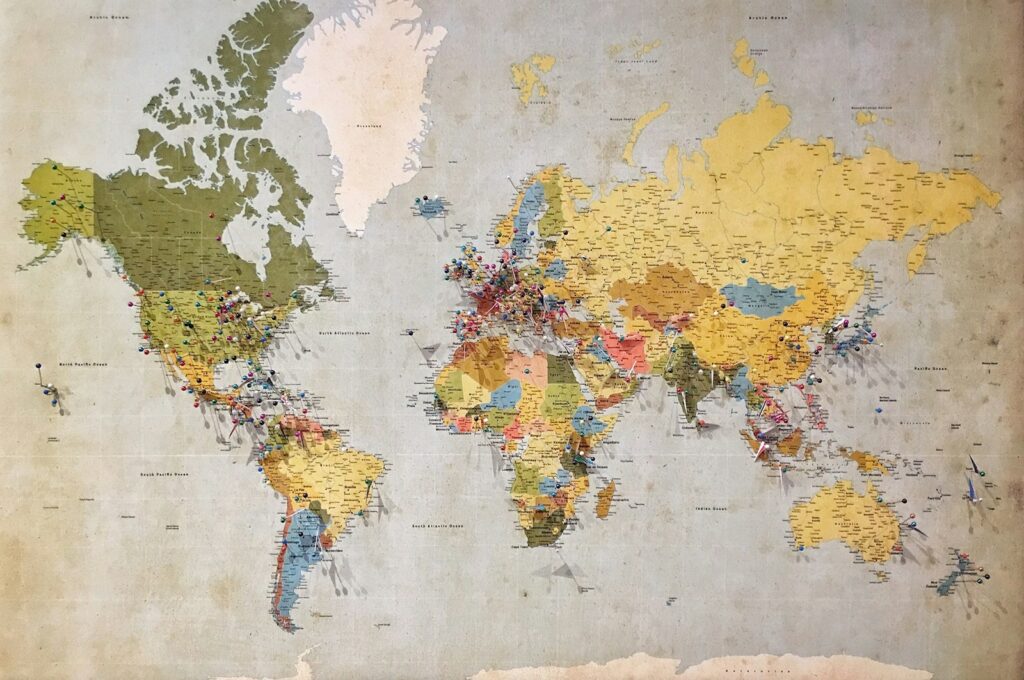
American Expats by Country: What the Available Data Can and Cannot Show

People often ask which countries have the most Americans living abroad. The short answer is that no single global register can provide an exact count. The most useful recent U.S. government estimate comes from the Federal Voting Assistance Program (FVAP), but it was built to understand the overseas voting population, not to rank every kind of expatriate.
This guide separates what the available evidence can support from what it cannot. It uses FVAP’s 2024 Overseas Citizen Population Analysis, published with a 2024 estimate of about 3.3 million U.S. citizens abroad, including roughly 2.2 million voting-age citizens. The figures below are modeled estimates rather than a census.
The clearest available country comparison
FVAP’s 2024 modeling identifies the following ten countries as the largest estimated destinations for U.S. citizens abroad. The date matters: these are 2024 estimates, not live population counters.
| Country | Estimated U.S. citizens abroad |
|---|---|
| Canada | 430,013 |
| United Kingdom | 265,576 |
| Japan | 145,572 |
| Israel | 126,767 |
| France | 121,166 |
| Germany | 107,187 |
| Australia | 86,557 |
| Mexico | 63,326 |
| Ireland | 61,910 |
| Switzerland | 55,654 |
Source: FVAP’s 2024 Overseas Citizen Population Analysis materials. These numbers should be read as modeled country estimates, not verified individual headcounts.
The table is useful for scale and broad comparison. It does not prove that one country is a better destination, that the people counted are permanent residents, or that every person primarily identifies as an expat. Some may be dual citizens, students, workers on temporary assignments, retirees, family members, or people whose connection to the United States is citizenship rather than birthplace.
Why there is no exact worldwide count
The United States does not require every citizen abroad to register a foreign address with a single central database. Host countries also collect different information under different legal and statistical systems. One country may classify residents by citizenship, another by birthplace, and another by permit type or usual residence.
FVAP therefore combines multiple sources, including foreign-government estimates, U.S. administrative information and academic data. Its methodology explains that country inputs are not perfectly uniform and that some values must be modeled, imputed or extrapolated. That is a sensible way to estimate a hard-to-observe population, but it also creates uncertainty.
Four datasets that answer different questions
| Dataset | What it is useful for | What it does not prove |
|---|---|---|
| FVAP Overseas Citizen Population Analysis | Estimated U.S. citizens abroad and the voting-age overseas population | Exact residence status, permanent settlement, tax filing or personal identity as an expat |
| UN DESA International Migrant Stock | Cross-country migrant-stock comparisons, generally by country of birth and sometimes citizenship | A complete count of current U.S. citizens or a measure identical to FVAP |
| IRS international filing data | Tax returns or forms processed under specific tax rules | Total Americans abroad; many filing units include more than one person and filing requirements vary |
| Embassy or consular registrations | Voluntary contact records used for consular communication | A universal population register; participation is not compulsory and travelers may register |
The UN Department of Economic and Social Affairs’ International Migrant Stock 2024 covers 233 countries and areas. It is valuable for international comparison, but its usual concept is country of birth, with citizenship used in some places. A U.S.-born resident who is no longer a U.S. citizen and a U.S. citizen born abroad can therefore fall into different categories depending on the dataset.
Citizenship, birthplace and residence are not interchangeable
Three questions can produce three different answers:
- How many U.S. citizens are currently abroad?
- How many people born in the United States live in another country?
- How many people who call themselves American expatriates live in that country?
FVAP is closest to the first question. UN migrant-stock tables are usually closer to the second. The third is partly a matter of identity and has no universal administrative definition.
Residence also needs a time threshold. A long-term resident, a semester-abroad student and a person on a six-month assignment may all appear in some sources but not others. Tourists should not be treated as residents. Military and diplomatic populations may be included, excluded or handled separately depending on the source.
How to interpret the country rankings responsibly
Use the table to understand relative scale, then investigate the destination itself. A large estimated American population may indicate established international schools, English-speaking professional networks, consular services or mature relocation infrastructure. It does not guarantee easy immigration, low taxes, affordable housing or a welcoming local labor market.
Country totals also hide geographic concentration. An American community may cluster in one metropolitan area, university town or border region. National figures tell you little about rents, transport, climate or coworking options in the city where you might actually live.
For practical relocation planning, compare official immigration rules, tax residence, healthcare access, housing and employment permissions separately. Our guide to full-service relocation companies explains what professional providers may cover, but no provider can replace official government eligibility checks.
What the estimates say about Canada and the United Kingdom
Canada and the United Kingdom lead the FVAP country estimates by a substantial margin. Shared language, long-standing family and business ties, education links and geographic proximity in Canada’s case may help explain the scale. Those are plausible contextual factors, not causal findings proven by the FVAP model.
The absolute numbers should also be viewed against each country’s overall population and immigration system. A large community in a large destination does not necessarily mean Americans are unusually concentrated there. Per-capita comparisons require compatible denominators and the same statistical definition across countries.
Why tax-return numbers are a poor substitute
U.S. citizens and resident aliens can have U.S. tax filing obligations while living abroad, but IRS counts measure filings under specific rules, not people. Some individuals are not required to file; others file jointly; dependants may be represented on a return; and a person can file from abroad without being a permanent expatriate.
Tax data is important for compliance planning, but it should not be converted into a population estimate without a defensible methodology. Anyone planning a move should check current IRS information and obtain qualified cross-border advice for their own situation.
A practical research method for prospective expats
Start with the country estimate, then move through five evidence layers:
- Confirm immigration options on the destination government’s website.
- Check whether remote work, local employment or self-employment is permitted under the intended status.
- Review official tax-residence rules and any U.S. filing obligations.
- Compare city-level housing, healthcare, transport and connectivity from dated sources.
- Speak with people in the relevant city while treating anecdotes as experience, not population evidence.
Keep dates beside every number. Population models, exchange rates, visa rules and cost data change at different speeds. A 2024 overseas-citizen estimate can still be the best available source in 2026, but it should be labeled as 2024 rather than presented as a current headcount.
Methodology and limitations
This article uses FVAP’s 2024 estimate for U.S. citizens abroad and its published country-ranking materials. It cross-checks definitions against UN DESA’s International Migrant Stock 2024 methodology and does not merge the two series. Figures have not been adjusted, summed with tax data or projected forward.
The result is a careful answer to a narrow question: where does FVAP estimate the largest U.S.-citizen populations abroad? It is not a census of all American expats, a quality-of-life ranking or a recommendation to move.
Sources and update date
Reviewed 23 November 2026. Primary sources: FVAP Overseas Citizen Population Analysis and UN DESA International Migrant Stock 2024. Definitions and country estimates should be rechecked when either publisher releases a newer edition.
- FVAP country estimates (official presentation)
- IRS guidance for U.S. citizens and resident aliens abroad
Cover photo: Andrew Stutesman / Unsplash.







Responses