

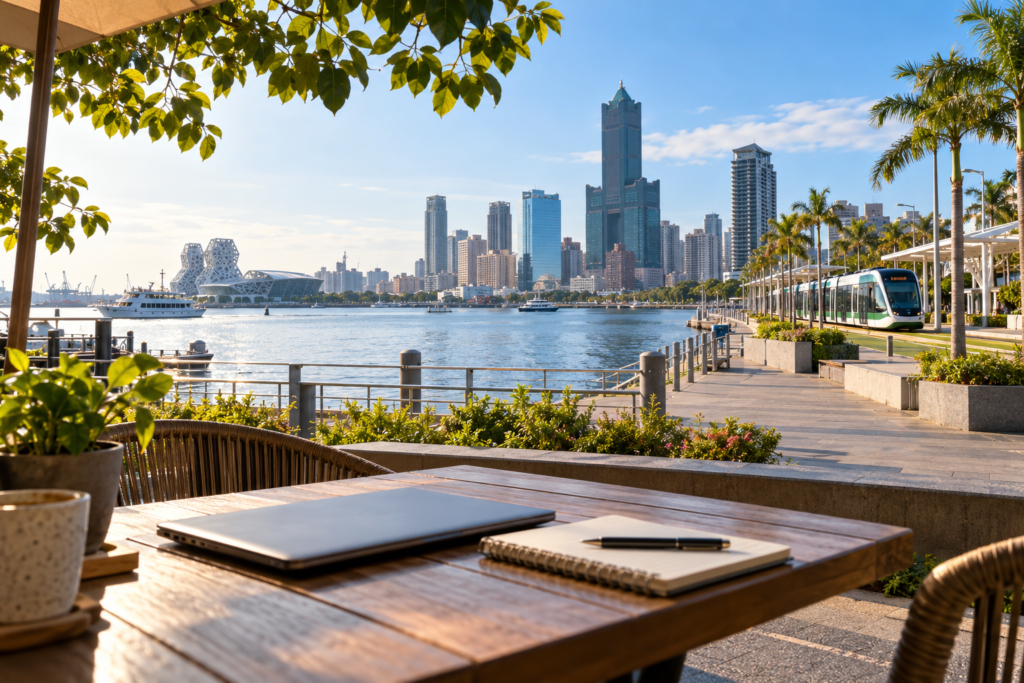
Kaohsiung, Taiwan: Digital Nomad Guide

Fact-checked: October 13, 2026. Kaohsiung offers big-city services, waterfront redevelopment, strong public transport and generally more space than Taipei. It is a practical southern Taiwan base for remote workers who prefer warm weather and a slower rhythm, provided they plan for humid summers, seasonal air-quality episodes and leases that may not suit a short stay.
This guide uses current Taiwanese government, city transport, climate, air-quality and workspace sources. The budget is a transparent scenario rather than a promise about what every resident will spend.
Kaohsiung at a glance
| Factor | Practical assessment |
|---|---|
| Best for | Public transport, waterfront life, food, city amenities and access to southern Taiwan |
| Main compromise | Hot wet summers, typhoon disruption and variable air quality |
| Strong first base | Central Park, Sanduo, Formosa Boulevard or another MRT-linked neighborhood |
| Coworking snapshot | Current official operator pages show day-pass options from NT$180 and monthly options from NT$2,500 |
| Planning budget | NT$59,300 per month for one person, excluding flights and visa fees |
Is Kaohsiung good for digital nomads?
Kaohsiung works best for remote workers who want a full Taiwanese city without Taipei’s intensity. Two MRT lines, the circular light rail, conventional rail and high-speed rail make car-free life realistic in the central area. Waterfront districts, markets, parks and day trips provide variety beyond work.
The compromises are climatic and administrative. Summers are hot, humid and wet; typhoons can interrupt transport and power. Some furnished housing is marketed around one-year leases, and English-language short-stay inventory is uneven. A careful first month should prioritize an MRT-linked address, tested internet and flexible housing.
For the capital’s deeper technology and international network, compare our Taipei digital nomad guide.
Visas and legal status
Taiwan’s current digital-nomad visitor-visa framework provides a multiple-entry stay of up to six months for eligible applicants, according to official talent and consular information. Requirements depend on nationality, prior digital-nomad status or income evidence, and the application route.
Taiwan’s Bureau of Consular Affairs updated its digital-nomad page on August 7, 2026. It states that an applicant already in Taiwan should apply at least 10 working days before the current period of stay expires. Do not treat that as a guarantee of approval or wait until the final day.
The visa is not the only legal question. Confirm tax residence, national health-insurance eligibility, employer rules and whether your activities fit the issued status. Use the official consular and Foreign Talent Act portals and check our Taiwan digital nomad visa guide and visa-extension update alongside the latest government text.
Best neighborhoods in Kaohsiung
Central Park and Formosa Boulevard
This central area gives direct MRT access, food, shopping and easy transfers. It is convenient for a first stay and keeps coworking and social options close. Check street and nightlife noise before committing to a unit.
Sanduo and Asia New Bay Area
Modern towers, malls, the harbor, light rail and event venues make this a polished base. It suits people who value waterfront walks and new buildings, though premium towers and short leases can raise the housing budget.
Yancheng and Pier-2
Yancheng mixes older streets with the Pier-2 arts district, harbor attractions and light-rail access. It has character and good weekend life. Apartment quality varies, so inspect humidity, windows, plumbing and soundproofing rather than choosing from a facade.
Zuoying
Zuoying is useful for frequent high-speed rail trips and access to Lotus Pond. It feels less central for harbor nightlife but can be calmer and more spacious. Choose an address near the MRT or high-speed rail station if connectivity is the purpose.
Lingya
Lingya covers a broad central area with residential streets, markets and convenient links. A current public rental example showed a one-room unit at NT$25,000 per month but required a one-year minimum, illustrating why price alone is insufficient. Confirm the lease term, management fee and furniture.
Housing and lease reality
Our model allocates NT$25,000 for a furnished studio or one-bedroom in a transit-linked area. Short-term inventory can cost more than local long leases, and some online listings are intended for residents able to provide deposits, local guarantors or annual commitments.
Before paying:
- confirm the legal contracting party and receive a written lease;
- identify deposit, management fee, electricity, water and internet charges;
- inspect air-conditioning, dehumidification, mold and exterior noise;
- test actual Wi-Fi and mobile reception inside the room;
- map the walk to an MRT or light-rail stop in heat and rain;
- clarify guest, package, rubbish and bicycle rules;
- avoid transferring a deposit based only on social-media messages.
Typhoon exposure and humidity make drainage, window seals and building maintenance practical concerns, not cosmetic details.
Coworking and remote-work setup
Kaohsiung has credible current workspace choices. Operator pages checked in October 2026 include:
- Wee: lists a NT$180 day pass, two locations, Wi-Fi, outlets and a phone booth.
- Second Space: advertises 24/7 and day-pass access at central locations; confirm the current access package directly.
- Storeasy: publishes monthly workspace from NT$2,500 and a day-pass option on its current page.
- Daoteng: offers flexible day-pass access; request current hours and availability.
Published prices and inclusions can change. We did not hands-on test these venues or their internet speeds. Ask about tax, deposits, call rooms, weekend access, monitors and refund rules before purchase.
For home work, use a wired connection where possible and keep a Taiwanese mobile-data backup. During typhoon warnings, charge equipment early and follow official closure and transport announcements.
Public transport
Kaohsiung’s MRT and light rail cover many useful districts. The official light-rail fare page currently lists a NT$20 base fare with distance-based charges up to NT$35. The city also launched a NT$399 QR monthly pass in 2026 for specified local transport; verify current eligibility, channels and coverage before relying on it.
Use a stored-value transit card for simple transfers and keep the official KRTC map offline. The high-speed rail station at Zuoying connects northward, while Kaohsiung International Airport is on the red MRT line.
Cycling is useful on waterfront routes, but heat and traffic make route choice important. Scooters require appropriate licensing, insurance and confident local-road skills; they are not necessary for a central first month.
Weather, typhoons and air quality
Kaohsiung’s official city information describes a tropical monsoon climate: winters are relatively dry, while summer and autumn are hot and wet. Heavy rain and typhoons can disrupt daily plans. Choose housing with good cooling and ventilation, and maintain a flexible work setup during severe-weather periods.
Air quality varies by day and season. Taiwan’s official Environmental Protection Administration publishes live AQI readings and health guidance. Check the current station rather than relying on an annual label. On poor-air days, reduce prolonged outdoor exertion as advised, close windows when appropriate and use effective indoor filtration.
Do not buy a mask or purifier solely from a marketing claim. Match filtration to official health guidance, room size and replacement-filter availability.
Food and everyday life
Night markets, breakfast shops, noodle and rice dishes, seafood, cafes and convenience stores make eating varied and accessible. Cooking some meals helps balance cost and nutrition. Our monthly model assigns NT$12,000 to a mix of local meals, groceries and occasional cafe food.
Taiwan’s recycling and rubbish systems can surprise new arrivals. Ask the landlord about building collection rather than assuming bags can be left outside. Convenience stores handle many payments and deliveries, though some services require local-language or local-phone support.
Mandarin is the dominant practical language, with Taiwanese Hokkien also common. Transit and major services have substantial bilingual support, but translation tools and a few Mandarin phrases improve housing, clinic and neighborhood interactions.
Healthcare, insurance and safety
Kaohsiung has major hospitals and clinics, but a visitor or new resident should confirm payment and insurance procedures before needing care. Taiwan’s national system eligibility depends on status and timing; do not assume a visitor visa creates immediate coverage.
The city is generally navigable with normal urban precautions. Traffic is the largest everyday hazard for many newcomers: look for turning scooters, use marked crossings and do not assume vehicles will yield. Save emergency and insurer contacts offline.
Our digital nomad insurance guide offers a framework for medical, evacuation, device and activity coverage. The policy wording controls.
Kaohsiung’s international community is smaller than Taipei’s but includes students, professionals, entrepreneurs and long-term foreign residents. Coworking venues, language exchanges, arts events and recurring fitness groups are practical entry points.
A useful strategy is to choose one weekly activity and one regular workspace rather than chase one-off meetups. Bilingual patience matters: a smaller English-language scene is not an absence of community.
Monthly budget for one remote worker
This is an editorial planning model for one person in a furnished, transit-linked apartment. It includes a coworking/cafe allowance and private insurance but excludes flights, visa fees, deposits, major electronics and extensive intercity travel.
| Category | Monthly amount |
|---|---|
| Accommodation | NT$25,000 |
| Utilities and home internet | NT$3,000 |
| Food and groceries | NT$12,000 |
| Local transport | NT$1,200 |
| Workspace and cafes | NT$4,000 |
| Phone and data | NT$800 |
| Health and fitness | NT$2,500 |
| Leisure and day trips | NT$5,000 |
| Insurance | NT$5,800 |
| Total | NT$59,300 |
Housing term is the largest uncertainty. A local annual lease may be cheaper, while a legal flexible furnished stay can cost more. The NT$1,200 transport line allows for a pass plus incidental trips; verify the current pass and your actual network use.
A practical first-week setup
- Book flexible accommodation near an MRT station.
- Compare Central Park, Sanduo, Yancheng and Zuoying in person.
- Test home internet and mobile signal before signing.
- Check humidity, drainage, windows and air-conditioning.
- Buy transit access and save official maps.
- Test one coworking day before buying a month.
- Save BOCA, weather, AQI, insurance and emergency links.
Frequently asked questions
Is Kaohsiung cheaper than Taipei?
Housing can be less expensive for comparable space, but short-term furnished supply and lease terms complicate simple comparisons. Use current listings for the exact month and neighborhood. Our Kaohsiung model totals NT$59,300 for one person; it is not a market average.
Can I live in Kaohsiung without a scooter?
Yes, if you choose an MRT- or light-rail-linked neighborhood. Central errands, the airport and the high-speed rail station are reachable by public transport. A scooter expands access but adds licensing, insurance and traffic risk.
Does Kaohsiung have coworking spaces?
Yes. Current operator pages list day-pass and monthly options, including a NT$180 day pass at Wee and monthly space from NT$2,500 at Storeasy. Confirm current price, hours, call facilities and availability directly.
How serious is the air-quality issue?
It is variable rather than a single permanent number. Check Taiwan’s official live AQI and follow its health advice. Housing ventilation, filtration and flexibility for outdoor exercise are sensible planning factors.
Is Taiwan’s digital nomad visa six months?
Official current information describes a multiple-entry digital-nomad visitor visa with a stay of up to six months for eligible applicants. Requirements and extension procedures are status-specific; use the current BOCA and talent portals.
Sources and methodology
Checked October 13, 2026:
- Taiwan Bureau of Consular Affairs: Digital Nomad Visa
- Taiwan Foreign Talent Act portal
- Kaohsiung Rapid Transit Corporation
- Kaohsiung City Government transport information
- Taiwan Air Quality Monitoring Network
- Current official pages for Wee, Second Space, Storeasy and Daoteng coworking
- Current public rental listings, used only to test the budget and lease-term caveat
No housing, workspace, connection speed or transport service was hands-on tested for this article. Budget amounts are identical in the table and both responsive charts.
Kaohsiung Monthly Budget: NT$59,300 (Illustrative)
One adult, one month. Planning allowances, not live quotes. See assumptions and exclusions.




Responses