

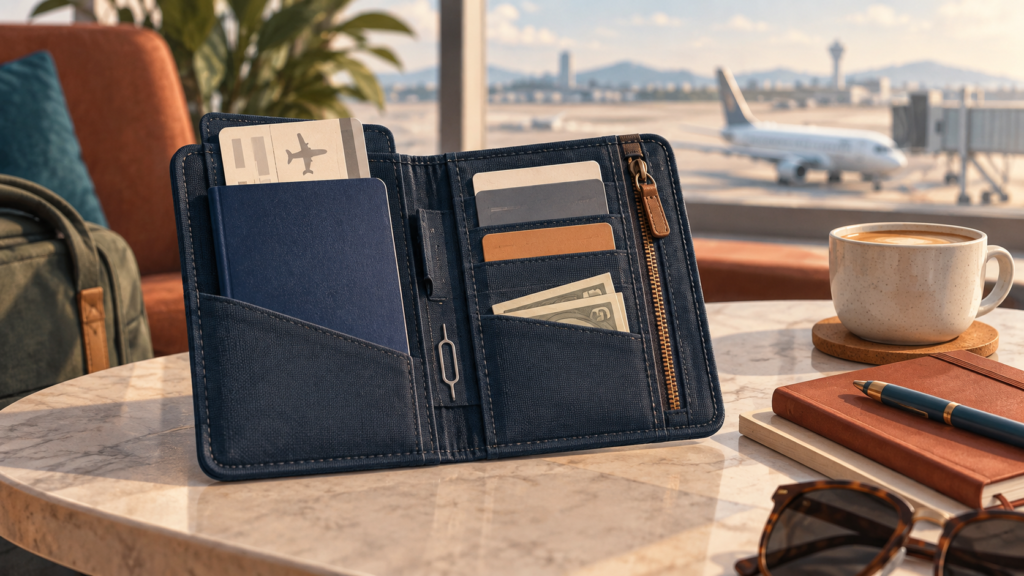
Best Travel Wallets for Digital Nomads: 5 Practical Options Compared

A travel wallet has a harder job than an everyday card holder. It may
need to hold a passport, backup cards, two currencies, a boarding pass
and a SIM tool—without turning every café payment into a rummage through
your documents.
This guide compares five current options using manufacturer
specifications, not hands-on testing. Prices are US list prices checked
on 17 September 2026 and can change by color, region or promotion. We
did not assign star ratings, test RFID performance or accept
manufacturer claims as independent proof.
Quick comparison
| Travel wallet | Best for | Passport capacity | Card storage | RFID claim | Listed US price* |
|---|---|---|---|---|---|
| Peak Design Passport Wallet | Slim, organized family or multi-passport carry | 2–3 passports | 8 cards | Not stated on the product page reviewed | $89.95 |
| ALPAKA Zip Travel Wallet | Zipped organization in a compact format | 3 internal passport pockets | 2 card slots | Yes | $49 |
| Pacsafe RFIDsafe Compact Travel Organizer | Security-focused everyday travel | Most passport sizes | 5 card slots | Yes | $59.95 |
| Fjällräven Passport Wallet | Simple fabric organizer with a coin pocket | Passport up to 125 × 90 mm | Multiple card slots | Not stated on the product page reviewed | $70 |
| Thule Aion Travel Organizer | One pouch for documents and small electronics | Detachable passport pouch | Card storage in RFID pouch | Yes, on detachable pouch | $64.95 |
*Prices checked on the brands’ US websites on 17 September 2026.
Taxes, shipping and regional prices are excluded.
How we compared travel
wallets
We started with a digital nomad’s practical carry list: passport, two
payment cards, a backup card, cash, travel documents and occasionally a
pen or SIM card. We then checked the brands’ current product pages for
dimensions, weight, stated capacity, closure and RFID claims.
The comparison does not treat “RFID blocking” as a quality score. It
records only whether the manufacturer makes that claim. A wallet also
does not replace sensible document security: carry only what you need
for the day, keep backup cards separate, and store encrypted copies of
essential documents. Our guide to protecting
identity and personal documents covers the wider system.
1.
Peak Design Passport Wallet: best for two or three passports
Peak Design’s Passport Wallet is the most purpose-built
multi-passport option in this group. The brand lists space for two to
three passports, eight cards, up to 15 bills and a pen. An expandable
construction is meant to stay relatively slim when lightly packed and
grow when more documents are added.
That layout makes sense for a couple carrying documents together, a
parent travelling with a child, or anyone who keeps a second passport.
It is less compelling if you want a zipped coin pocket or explicitly
require an RFID-blocking layer; neither feature is stated on the product
page we reviewed.
The listed US price was $89.95. Check the Peak Design
Passport Wallet specifications before buying, especially if your
passport is an unusual size.
Choose it if: multi-passport capacity and separated
access matter more than minimum price.
2.
ALPAKA Zip Travel Wallet: best compact zipped organizer
ALPAKA’s Zip Travel Wallet combines a full zip closure with three
internal passport pockets, two card slots and a front pocket intended
for tickets. The brand lists RFID blocking, YKK silent zippers and an
Axoflux recycled ripstop nylon exterior.
At 11.5 × 18.8 × 2.2 cm and 130 g, it is still a document organizer
rather than a trouser-pocket wallet, but it is substantially smaller
than a tech pouch. The two dedicated card slots may be limiting for
people who carry several business and personal cards; the passport
pockets can hold more, but that sacrifices the clean separation the
design is meant to provide.
The listed price was $49. See the current ALPAKA Zip
Travel Wallet page for colors and availability.
Choose it if: you want passports and boarding
documents behind one zipper without carrying a larger electronics
organizer.
3.
Pacsafe RFIDsafe Compact Travel Organizer: best security-focused
layout
Pacsafe’s compact organizer has five card slots, passport storage,
space for flat bills and coins, a boarding-pass pocket, pen loop and
SIM-card pocket. The company states that its material blocks RFID
signals and that the organizer fits most passport sizes.
Its listed measurements are 6.4 × 4.5 × 0.8 inches and its weight is
0.22 lb. That is a useful middle ground: more structure than a passport
sleeve, but smaller than a general travel pouch. Recycled polyester is
used in the shell according to the brand.
The listed price was $59.95. Review the Pacsafe
RFIDsafe Compact Travel Organizer for the latest materials and
stock.
Choose it if: you want dedicated places for cards,
coins and a SIM card, plus a manufacturer-stated RFID layer.
4.
Fjällräven Passport Wallet: best simple fabric organizer
Fjällräven’s Passport Wallet uses the company’s G-1000 HeavyDuty
fabric and keeps the layout conventional: money, cards and passport
storage, plus a zipped coin pocket. It measures 16 × 11 × 2 cm and
weighs 140 g.
The important caveat is passport size. Fjällräven lists a maximum of
125 × 90 mm, so measure any non-standard document rather than assuming
it will fit. The product page we reviewed did not state an RFID-blocking
feature.
The listed price was $70. Current colors and dimensions are on the Fjällräven
Passport Wallet page.
Choose it if: you prefer a straightforward zip
wallet with a coin compartment and do not need a multi-passport
layout.
5.
Thule Aion Travel Organizer: best for documents plus tech
accessories
The Thule Aion is the outlier here. It is a larger 2-in-1 organizer
with storage for currency and small electronics, plus a detachable zip
pouch for a passport and cards. Thule states that the detachable pouch
has RFID blocking. The main organizer also includes a hand strap and pen
loop.
At 10.8 × 5.1 × 6.9 inches, it is closer to a small tech pouch than a
wallet. That can be useful if you want one grab-and-go unit for travel
day, but it is unnecessarily bulky if you need something that lives in a
jacket pocket. The brand lists 100% recycled waxed 600D canvas and a
weight of 0.31 lb.
The listed price was $64.95. See Thule’s
Aion Travel Organizer for current specifications.
Choose it if: you want passports, currency, cables
and small accessories in the same pouch.
How to choose the right
travel wallet
Start with the
documents you actually carry
A solo traveller with one passport and three cards does not need the
same capacity as a family. Make a literal stack of your travel
essentials, then check the stated dimensions. Remember that a second
currency and paper receipts can quickly turn a slim wallet into an
overfilled one.
Decide where the wallet will
live
For a front pocket or small crossbody, prioritize compact dimensions
and fast access. For a backpack, a zipped organizer may be easier to
identify and harder to spill. A larger pouch such as the Thule makes
most sense when it replaces a separate tech organizer.
Treat
RFID as one feature, not the whole security plan
Manufacturer-stated RFID blocking may be reassuring, but it does not
protect against loss, card-not-present fraud or a stolen unlocked phone.
Keep a backup card somewhere else, enable transaction alerts and know
how to freeze each card quickly.
Check passport fit and
return terms
Passport dimensions vary. A cover can also make a standard passport
too thick for a tight sleeve. Confirm the internal measurements and
regional return policy before ordering.
Plan the rest of your carry
A wallet works best as part of a deliberate packing system. Our digital
nomad packing list for Europe helps separate daily-access items from
backups and luggage-only gear.
Our practical picks
The ALPAKA is the strongest value on published specifications for
travellers who want a zipped, multi-passport organizer. Pacsafe is the
most compartmentalized compact option. Peak Design suits people carrying
several passports and cards who are willing to pay more. Fjällräven
keeps things simple, while Thule makes sense only if its larger
tech-and-document format replaces another pouch.
Those are fit recommendations based on documented features—not claims
that one product is universally “best.” Stock, prices and materials can
change, so recheck the linked manufacturer page before buying.
Frequently asked questions
Do digital
nomads need an RFID-blocking wallet?
Not necessarily. Some travellers value the feature, but loss
prevention, separate backup cards, strong account security and rapid
card-freezing access are more broadly useful. We record RFID only where
the manufacturer explicitly claims it.
Should I keep
all my cards and passport together?
Usually not. A travel wallet can organize what you need in transit,
but carrying every payment method in one place creates a single point of
failure. Keep at least one backup card and copies of key details
separately.
Is a passport
cover the same as a travel wallet?
No. A passport cover usually protects one booklet. A travel wallet
adds card, cash and document storage, often with a zip or snap
closure.
Which wallet works
for multiple passports?
Peak Design states capacity for two to three passports, while ALPAKA
lists three internal passport pockets. Always compare your documents
with the current internal dimensions before ordering.












Responses